
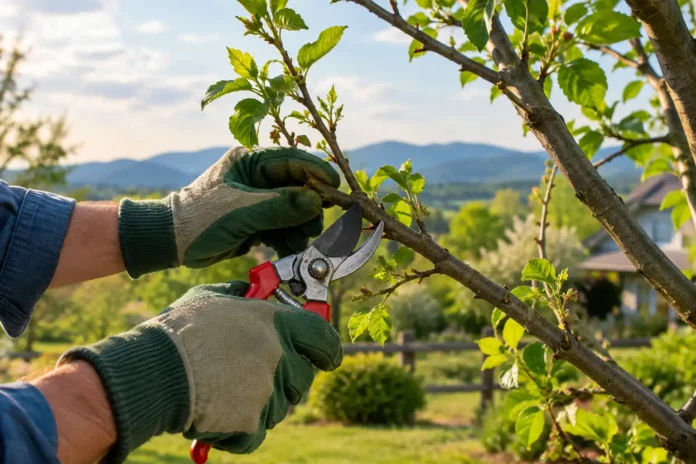

In Upstate SC, the best time to prune a tree depends on its species, flowering habits, current health, branch structure, and location on the property. A dogwood near a front walk, a mature oak over a roof, and a pine beside a driveway each require a different approach. Homeowners seeking professional tree pruning in Upstate SC benefit from a plan that accounts for the tree’s growing season rather than relying on a single calendar date.
From Chesnee and Spartanburg to Boiling Springs, Gaffney, Greer, and nearby Upstate communities, trees contend with humid summers, quick spring growth, heavy thunderstorm winds, and occasional winter cold snaps. Properly timed pruning can improve clearance, remove damaged limbs, guide young-tree structure, and preserve the natural character of a landscape without creating unnecessary stress. Soil conditions, recent construction, lawn equipment damage, and limited root space can also affect how well a tree responds to pruning, especially when it is already under stress.
Why Pruning Timing Matters in Upstate South Carolina
Pruning is more than removing branches that look too long or crowded. Every cut changes how a tree directs energy and how it responds with future growth. In the Upstate’s extended growing season, an untimely cut can lead to dense sprouts, lost flower buds, sun exposure on previously shaded limbs, or recovery issues during periods of heat and drought.
Timing also matters because local trees do not all grow alike. Oaks, maples, magnolias, pines, crepe myrtles, dogwoods, and ornamental cherries have different growth patterns. Clemson Cooperative Extension notes that pruning at the wrong time can reduce flowering and may increase a plant’s susceptibility to insects, disease, or winter damage. Its guidance is especially useful for homeowners deciding whether to cut now or wait for a more favorable season.
Weather patterns matter as well. Late-winter work can be easier to schedule before the busiest spring landscape season, while summer pruning may be limited to safety needs and modest corrective cuts. A recently transplanted tree, a drought-stressed tree, or one showing leaf discoloration may need a more conservative approach than a healthy, well-established specimen. Pruning should support recovery and structure rather than add another source of stress.
Routine Pruning Versus Urgent Pruning
Routine seasonal pruning
Routine pruning is planned work intended to improve structure, create clearance, remove rubbing branches, or maintain a tree’s natural shape. For many deciduous shade trees in Upstate SC, late winter is a practical time to evaluate branch arrangement because the canopy is easier to see before new leaves obscure the framework. Selective cuts can address crossing limbs, weak attachments, and crowded growth before spring development begins.
Routine work is also a chance to correct small issues before they become expensive problems. For example, a young tree with two competing leaders may benefit from early structural pruning, while a low limb over a sidewalk can be raised gradually over several visits. Removing too much live foliage at once can reduce the tree’s ability to produce energy, so a careful pruning plan focuses on priority branches rather than making every possible cut in one day.
Urgent safety pruning
Urgent pruning follows a different schedule. A cracked limb above a driveway, a broken branch hanging after a summer storm, or dead wood over a play area should not wait merely because it is not the ideal pruning season. The immediate goal is to reduce a hazard while preserving as much healthy structure as possible. Branches touching or approaching utility lines should never be handled by a homeowner.
After severe weather, it is wise to look for limbs that are suspended in the canopy, fresh splits at branch unions, exposed wood, lifted roots, or a newly leaning trunk. Not every damaged branch is obvious from the ground, and a branch that remains attached after a storm may still fail later. Keeping people, pets, vehicles, and outdoor equipment away from the affected area is often the safest first step until a qualified professional can inspect the tree.
Matching the Cut to Common Upstate Trees
- Dogwoods and redbuds: These early bloomers commonly form flower buds before spring. Pruning after the flowers fade helps preserve the following season’s display while allowing removal of damaged or poorly placed branches.
- Crepe myrtles: Corrective pruning is often scheduled during dormancy. The objective is to maintain strong trunks and a graceful canopy, not to cut the tree back to bare stubs. Severe topping creates weak, fast regrowth and an ongoing maintenance problem.
- Maples and birches: These trees can produce noticeable sap flow when cut at certain times. The flow is usually not harmful, but pruning after leaves mature can reduce the mess and limit insect attraction.
- Oaks: Mature oaks deserve a careful, conservative approach. Selective removal of deadwood, weak unions, and limbs over structures can improve safety, while excessive live-wood removal can stress an established tree.
- Pines: Pines generally need less routine pruning than broadleaf trees. Removing hazardous limbs and managing young growth requires care because many conifers will not replace growth cut back into old, bare wood.
- Magnolias: Magnolias often develop an attractive natural form with minimal cutting. Young trees may benefit from structural guidance, but mature trees should not be aggressively thinned simply for appearance.
Species identification is important because the same cut can have different results on different trees. A pruning approach that works well for a fast-growing ornamental may be inappropriate for a mature native shade tree. When possible, retain healthy branch collars and make cuts just outside them rather than leaving long stubs or cutting flush against the trunk. Proper cut placement helps the tree close wounds naturally and reduces avoidable damage.
How Pruning Supports Storm Readiness
Summer thunderstorms are part of life in the Upstate. Saturated ground, sudden wind gusts, and heavy foliage can expose defects that were difficult to see earlier in the year. Pruning cannot make a tree stormproof, but it can address obvious concerns before weather puts extra pressure on the canopy.
A professional assessment may identify long limbs with heavy end weight, dead branches over a roof, limbs rubbing together, narrow V-shaped branch unions, fresh cracks, or limbs growing into a house, fence, street, or driveway. Selective thinning and reduction are not the same as canopy stripping. The goal is to make purposeful cuts that retain a balanced, functional crown.
Clearance pruning can be particularly valuable around roofs, gutters, service entrances, driveways, and frequently used walkways. However, removing branches solely because they are near a structure is not always the answer. A qualified assessment considers branch size, direction of growth, attachment strength, canopy balance, and whether a reduction cut can provide clearance without unnecessarily removing a major limb.
Why Topping Is Not a Solution
When a tree appears too tall for its setting, topping can seem like the fastest answer. In reality, cutting major limbs to arbitrary stubs often creates large wounds and encourages multiple weak shoots below the cuts. Those shoots can grow quickly, become crowded, and create future breakage risks.
A better option may be selective crown reduction back to suitable lateral branches, removal of a specific overextended limb, crown raising for clearance, or, in some cases, removal of a tree that has outgrown its site. The right recommendation depends on the tree’s condition, available space, and the risk it presents to people and property.
Homeowners should also be cautious about requests to make a tree “look even” by removing large amounts of foliage from one side. Trees do not always grow symmetrically, and aggressive shaping can create more problems than it solves. Preserving a tree’s natural form while making targeted improvements is generally a safer, healthier long-term strategy.
What a Professional Pruning Visit Should Consider
A useful pruning plan starts with the tree itself. Before work begins, the crew should identify the species, inspect the trunk and branch unions, assess dead or declining wood, consider the tree’s age and vigor, and review nearby roofs, vehicles, walkways, fences, and utility lines. The desired outcome also matters. Safety, storm preparation, clearance, flowering, appearance, and long-term structure are not always solved by the same cuts.
A complete visit may also involve discussing access for equipment, protecting nearby landscaping, identifying whether permits or neighborhood requirements apply, and deciding how debris will be managed. For some trees, monitoring a questionable branch over time is more appropriate than immediate removal. For others, visible decay, extensive cracking, or repeated branch failures may change the recommendation from pruning to removal.
Location: Warrior Tree Service LLC | 520 S 962, Chesnee, SC 29323 | (864) 278-2555 | https://warriortreeservicessc.com/
When to Request Professional Tree Pruning in Upstate SC
It is time to request an evaluation when branches are large, high above the ground, cracked, decayed, or extending over a roof or traffic area. Professional help is also appropriate after storm damage, when a tree has been topped, when a homeowner is unsure about a flowering tree’s schedule, or when the work involves ladders, climbing, heavy equipment, or exposure to utility lines.
Thoughtful pruning respects the growing season while responding quickly to real hazards. In Upstate South Carolina, the best cut is not simply the one made first. It is the one made for a clear reason, at an appropriate time, and with the tree’s long-term structure in mind.