
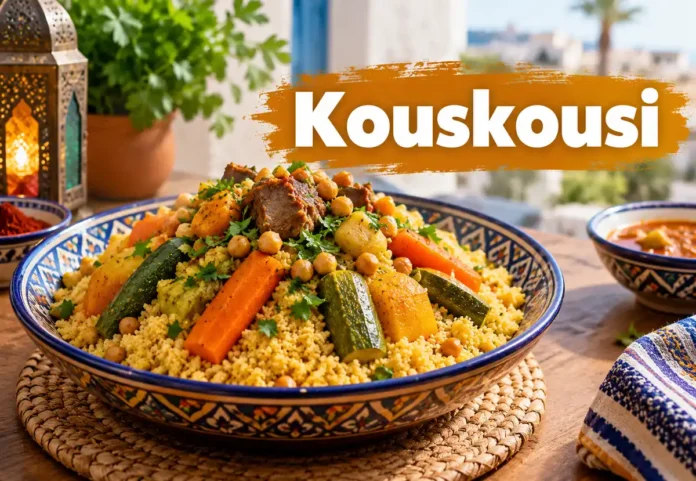

Kouskousi is the traditional North African name for couscous, a dish made from tiny steamed granules of durum wheat semolina. The word is most commonly used in Tunisian Arabic, though close variants appear across Morocco, Algeria, and Libya. Kouskousi refers both to the semolina itself and to the finished meal, which is usually topped with a vegetable, meat, or fish stew. It is one of the oldest and most widely eaten dishes in the Maghreb region.
Where the Word Kouskousi Comes From
The term kouskousi traces back to Berber (Amazigh) roots, the indigenous language family of North Africa long before Arabic became dominant in the region. Linguists generally trace it to words like “seksu” or “kseksu,” which referred to the rolling and steaming of semolina grains. As Arabic spread across the Maghreb, the pronunciation shifted into forms such as kesksi and kouskousi, which is why the spelling and sound of the word still differ slightly from Tunisia to Morocco. Despite these small variations, every version points to the same underlying dish and cooking method.
Food historians place the origins of kouskousi somewhere in the medieval period, developed by Berber communities in what is now Algeria, Morocco, and Tunisia. In December 2020, UNESCO added the knowledge and practices linked to couscous to its Representative List of the Intangible Cultural Heritage of Humanity, following a joint submission from Algeria, Mauritania, Morocco, and Tunisia. That recognition reflects how deeply kouskousi is tied to shared cultural identity across borders, rather than belonging to any single country.
What Kouskousi Is Actually Made Of
At its core, kouskousi is made from durum wheat semolina, water, and a small amount of salt. The semolina is sprinkled with water and rolled by hand into tiny granules, then coated lightly with flour to keep the grains separate during cooking. This rolling stage is traditionally done in a wide, shallow dish and takes real skill, since the size and evenness of the granules affect how the dish steams. Some households and regions also make coarser semolina versions or barley-based kouskousi, particularly in mountain communities where wheat was historically less available.
The stew served over kouskousi is where most of the flavor and variation comes from. A typical stew might include lamb, chicken, or fish, along with vegetables like carrots, turnips, zucchini, chickpeas, and cabbage. Spices such as cumin, paprika, turmeric, and sometimes harissa are common, especially in Tunisian versions of the dish. The semolina itself stays relatively plain, which lets it absorb the broth and flavors from whatever it is served with. Northern European kitchens use the same idea, and a creamy Swedish flaskfilegryta recipe made with pork tenderloin and paprika is often spooned over rice or couscous.
How Kouskousi Is Traditionally Steamed
The defining feature of authentic kouskousi is that it is steamed, not boiled. Traditional cooks use a two-part pot called a couscoussier, with a stew simmering in the bottom section and the semolina resting in a perforated steamer basket on top. Steam rises through the semolina as the stew cooks below, which slowly cooks the grains while infusing them with the aroma of the broth. This process is typically repeated two or three times, with the semolina removed, fluffed with water, and returned to the steamer between rounds.
This multi-round steaming is what gives properly made kouskousi its light, fluffy texture rather than a dense or gummy one. Cooks fluff the grains by hand between steamings to break up clumps and let air in, which is a skill passed down within families rather than something written into a fixed recipe. The full process from rolling the semolina to final steaming can take a few hours, which is one reason kouskousi has traditionally been a weekend or special-occasion dish in many households.
Regional Versions of Kouskousi Across North Africa
Kouskousi is not one fixed recipe. It shifts noticeably depending on where it is made, and each country has developed its own signature approach.
- Tunisia: Often the spiciest version, made with harissa, tomato paste, and commonly served with lamb, fish, or octopus depending on the coastal or inland region.
- Morocco: Frequently associated with a Friday family meal, sometimes prepared with seven vegetables, and also appears in a sweet form called seffa, dusted with cinnamon and sugar.
- Algeria: Commonly made with chickpeas, raisins, and a lighter broth, with regional versions varying between coastal cities and the interior.
- Libya: Tends to use a spicier tomato-based stew, often with lamb and a distinct blend of local spices.
These differences mean that asking what kouskousi tastes like does not have one single answer. The base grain stays similar, but the stew, spice level, and accompanying meat or vegetables change from household to household and country to country.
Kouskousi vs. the Instant Couscous Sold in Stores
Most couscous sold in supermarkets outside North Africa is pre-steamed and dried during manufacturing, which is why it can be prepared in five minutes by simply adding boiling water. This instant version is convenient, but it skips the multi-round steaming process that defines traditional kouskousi. The texture ends up noticeably different, since instant couscous tends to be softer and less airy than the hand-rolled, repeatedly steamed version made at home.
It’s also worth separating kouskousi from pearl couscous, sometimes labeled Israeli couscous, which is a much larger, toasted pasta shape rather than a fine semolina grain. Pearl couscous is a modern product developed for different cooking methods and has a chewier bite, closer to small pasta than to traditional semolina. When people search for what kouskousi actually is, they are almost always asking about the fine, traditional North African version rather than either of these commercial alternatives.
Nutrition: What You Get in a Bowl of Kouskousi
Since kouskousi is made from durum wheat, it is primarily a carbohydrate source, providing steady energy without a heavy fat content. A typical cooked serving offers a moderate amount of plant-based protein, some fiber, and small amounts of B vitamins and minerals like selenium and magnesium. Because it is a wheat product, kouskousi contains gluten and is not suitable for people with celiac disease or gluten sensitivity. Whole wheat semolina versions offer somewhat more fiber than refined semolina, though both are common depending on the region and household.
The overall nutritional value of a kouskousi meal depends heavily on what is served with it. A version loaded with vegetables, lean meat, and legumes offers a more balanced plate than one served mostly with refined semolina and little else. This is one reason nutrition advice around kouskousi tends to focus on the whole meal rather than the semolina in isolation.
How Kouskousi Is Served and Eaten
Kouskousi is traditionally served on a large communal platter, with the semolina mounded in the center and the stew, vegetables, and meat arranged on top or around it. Broth is often ladled over the semolina just before eating to keep it moist. In many households, everyone eats from the same large dish, using a spoon or, in some traditional settings, their hands, which reinforces the dish’s role as a shared, social meal rather than an individually plated one.
Leftover kouskousi is sometimes reheated by steaming again briefly, which helps restore some of its original texture better than microwaving does. Some families also repurpose leftover semolina into simple next-day dishes, mixed with a little oil or butter and reheated gently. This flexibility is part of why kouskousi has remained a practical staple rather than a dish reserved only for special events.
Why Kouskousi Still Matters in North African Family Life
Beyond its role as food, kouskousi carries strong social weight in many North African households. In Morocco, preparing kouskousi on Fridays is a long-standing custom tied to the weekly day of communal prayer and family gathering. Weddings, religious holidays, and other celebrations across the Maghreb frequently feature large batches of kouskousi, since the dish scales well for feeding extended family and guests.
The labor involved in traditionally making kouskousi, from rolling the semolina to managing multiple steaming rounds, has also made it a dish associated with intergenerational teaching. Recipes and techniques are typically passed from mothers and grandmothers to younger family members rather than written down in fixed measurements. This oral tradition is part of what UNESCO’s 2020 recognition specifically acknowledged, treating kouskousi and its regional cousins as living cultural heritage rather than just a recipe.
FAQs
Is kouskousi the same thing as couscous?
Yes. Kouskousi is a regional name, most common in Tunisian Arabic, for the same dish widely known as couscous in English, made from steamed durum wheat semolina.
Is kouskousi gluten-free?
No. Kouskousi is made from durum wheat semolina, which contains gluten, so it is not suitable for people with celiac disease or gluten intolerance.
What is kouskousi traditionally cooked in?
It is traditionally steamed in a two-part pot called a couscoussier, with stew simmering below and semolina steaming in a perforated basket above it.
How is homemade kouskousi different from instant couscous?
Homemade kouskousi is hand-rolled and steamed in multiple rounds, giving it a lighter texture, while instant couscous is pre-steamed and dried for a quick five-minute preparation.
What is usually served with kouskousi?
It is typically topped with a stew of lamb, chicken, or fish along with vegetables such as carrots, turnips, chickpeas, and zucchini, with broth ladled over the semolina.
Is pearl couscous the same as kouskousi?
No. Pearl or Israeli couscous is a larger, toasted pasta shape, while kouskousi refers to the fine, traditional North African semolina grain.
Why was kouskousi recognized by UNESCO?
In December 2020, UNESCO added couscous, including kouskousi, to its Intangible Cultural Heritage list following a joint submission from Algeria, Mauritania, Morocco, and Tunisia.
Which country is kouskousi originally from?
It developed among Berber communities across the Maghreb, with Morocco, Algeria, and Tunisia all sharing deep historical ties to the dish rather than one single country of origin.

