
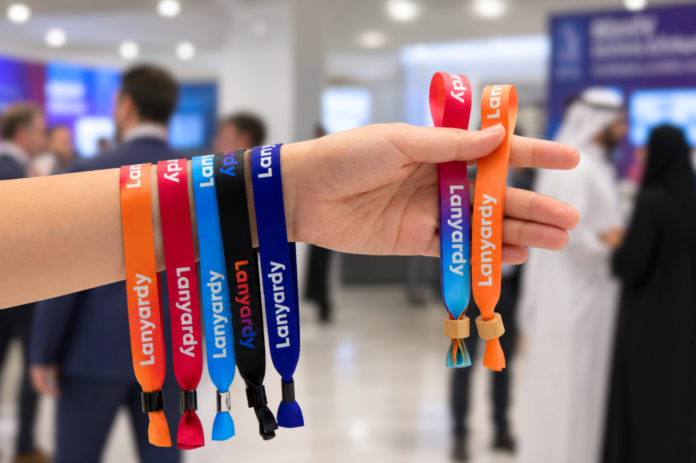

An event credential does several jobs at once. It helps staff decide who may enter, gives attendees a way to identify one another, and carries the event’s visual identity through the venue. When wristbands, lanyards, and badges are planned separately, organizers can end up with attractive items that create confusion at the entrance or fail to communicate access clearly.
A better starting point is the attendee journey: arrival, registration, movement between spaces, and departure. Each credential should answer a practical question along that route. Does this person have admission? Which areas may they use? What name or role should others see? Choosing the right combination begins with those questions, before artwork or materials are approved.
Give each credential a clear purpose
Wristbands are useful when staff need a quick visual admission check and attendees should keep their credential on while moving around. A lanyard holds a badge where people can see it. The badge carries information, such as a name, organization, role, or access category. These items can work together, but an event does not automatically need all three.
A conference may prioritize readable name badges for networking, while a music event may place greater emphasis on admission wristbands. An exhibition can require visitor badges alongside visibly different staff credentials. For organizers researching Custom wristband Lanyards Badges for Event, Xinyetong’s website presents these related product categories in one place, making the resource relevant to planning a coordinated credential system.
Decide which item is authoritative if someone presents conflicting credentials. For example, a badge might identify a speaker while a wristband confirms access to an evening reception. Staff need a clear rule for that distinction. A printed role should never be assumed to grant every kind of access.
Map access categories before choosing colors
List the groups attending the event and the spaces each group may use. General attendees, exhibitors, volunteers, speakers, contractors, and production staff may have different requirements. Keep categories limited to operational differences that staff actually need to recognize. Too many variations make ordering more complicated and increase the chance of a credential being issued incorrectly.
Use plain labels alongside color. A blue badge marked “Exhibitor” communicates more clearly than blue alone, particularly under uneven lighting or for people who have difficulty distinguishing colors. If access changes by day, make the valid day easy to see. Agree on a single naming system across tickets, registration records, badges, wristbands, and staff instructions.
Match wristbands to duration and conditions
Start with how long the wristband will be worn and what the wearer will be doing. An indoor evening event has different requirements from a weekend festival with rain, heat, and repeated entry checks. Ask about the material, print durability, fit range, and closure, then examine a sample under conditions similar to those expected at the venue.
For admission control, consider how a closure behaves after removal. Some designs are intended for one-time use; others are reusable. Confirm the exact construction rather than assuming that every wristband prevents transfer. A recognizable design helps visual checks, but appearance alone does not establish that a credential is authentic or assigned to the right person.
Comfort matters because attendees may wear the band for hours. Check for rough edges, awkward fastening, and print that becomes hard to read when the band bends around a wrist. If the event includes water activities, confirm the suitability of the complete product, including the closure and any embedded component.
Design badges for conversations and quick checks
A badge should be readable at a useful distance. Put the attendee’s name prominently, followed by the organization or role when that information helps the event. Keep sponsor logos and decorative elements from crowding essential details. A layout that looks balanced on a screen may produce small, difficult text when printed at actual size.
Check a physical proof while it is worn, not only while it lies flat on a desk. A badge can turn around, tilt, or sit too low for easy reading. Two-sided printing may help when badges frequently flip. Confirm the attachment position and orientation before approving the design.
If the badge includes a scannable code, test it with the intended scanning device and software. Leave enough clear space around the code and avoid backgrounds that interfere with recognition. Consider whether a visible code exposes information unnecessarily. The registration system should determine what a scan reveals and which staff members can access it.
Choose lanyards around the badge and wearer
The lanyard must support the badge’s size, weight, and attachment points. A decorative strap is of little use if its clip does not fit the badge holder or allows the credential to detach during normal movement. Ask for the full assembly, including the strap, connector, holder, and any release mechanism, when reviewing samples.
Consider the activities attendees and staff will perform. Where snagging is a concern, assess an appropriate breakaway design with the venue team. Check how any release mechanism works in the actual sample. Strap width, texture, and length also affect comfort, especially when a badge will be worn throughout a long working day.
Add technology only when the workflow needs it
Radio-frequency identification, or RFID, allows a compatible reader to detect an embedded tag. It can support an event workflow when paired with the right readers, software, and operating procedures. Buying a credential with a chip does not by itself create entry control, attendance tracking, or payment capability.
Before choosing a technical credential, confirm compatibility with the system provider. Test a sample through registration, activation, scanning, replacement, and deactivation. Include situations such as duplicate scans, a lost credential, or a connection failure. Decide who can resolve each problem and what staff should do while the system is unavailable.
A simpler visual credential may be sufficient for a small event with straightforward access. Where scanning solves a real operational problem, budget for the supporting system and training as well as the physical item.
Approve the complete order with a practical checklist
Ordering becomes easier when the supplier receives a consistent specification. Separate essential requirements from optional design preferences, and identify who can approve changes. A useful preproduction review includes:
- Quantities for each attendee category, with a reasoned allowance for replacements and late additions.
- Final artwork, spelling, access labels, print dimensions, and readable proofs at actual size.
- Material samples, wristband closures, lanyard connectors, badge holders, and assembly compatibility.
- Confirmed production milestones, delivery arrangements, and time to inspect the shipment before the event.
- Working scan tests for any codes or chips, including replacement and cancellation procedures.
Ask how different categories will be packaged and labeled. Separate cartons or clearly marked bundles can help registration staff avoid mixing credentials. On arrival, inspect the products against the approved proof and record any discrepancies early enough to arrange a remedy.
Plan distribution, replacement, and reuse
Credentials should fit the registration process. Prepare staff instructions for checking eligibility, issuing the correct category, and handling a replacement request. Store spare items securely and establish when an old credential must be canceled. An effective product can still cause delays if every exception requires staff to improvise.
For waste reduction, consider what can realistically be collected and used again. An undated lanyard may suit repeated events, while a personalized badge may not. Ask for specific information about recycled content and disposal options rather than relying on broad environmental descriptions. The value of reuse depends on collection, sorting, storage, and the condition of returned items.
Build a system attendees can understand
The strongest credential plan connects product choice with clear access rules, readable design, and practiced staff procedures. Wristbands can support admission checks, badges can make identities and roles visible, and lanyards can keep that information accessible. Each item earns its place by making a specific part of the event easier to run.
Start with the attendee journey, test the assembled products, and approve the order against a complete specification. That preparation helps organizers create credentials that look consistent and serve their purpose throughout the event.