Randleman heavy towing means a crew that shows up with a rotator, wreckers, cleanup gear and enough trained people to turn an overturned truck into an open road again. That’s the short version. The long version is more useful, because heavy recovery isn’t really about lifting. It’s about the order you do things in, and that only makes sense when you see it happen. So instead of a list of services, you’ll walk through two real jobs this crew handled: a torn-open reefer trailer that took 16 hours in a storm, and a fully loaded garbage truck that went from rolled to cleared in about two. You’ll see what equipment rolled out, why the cargo came first, and how the rigging kept a heavy truck from slamming back down. After that, you’ll get the lessons that apply to your own truck, what changes when you’re farther out in Greensboro or Winston-Salem, and who honestly doesn’t need a heavy crew at all.
Randleman Heavy Towing Isn’t One Truck, It’s a Plan
Most people picture heavy towing as one big wrecker hooking one big truck, but a real recovery looks more like a small job site. Randleman Towing runs a 30-truck fleet out of yards in Randleman and High Point. At the heavy end sits the Dominator, a 2023 Peterbilt 389 carrying a 50/60-ton rotator. It works next to 30-ton wreckers, air-cushion recovery systems, and multi-truck setups for loads over 100,000 pounds. The operators hold WreckMaster, Traffic Incident Management and 40-hour HAZWOPER certifications from NC State, which matters the moment fuel or cargo hits the ground. And the company also brings support gear people forget about, like skid steers, dump trailers, rollbacks and a hazmat mitigation truck. That’s because the truck is rarely the only problem on a heavy scene. Spilled freight, leaking fluids, soft ground and live traffic all have to be handled, usually at the same time and often in bad weather. Personally, I think that’s the real test of a heavy crew: not how big the rotator is, but whether it shows up with everything needed to finish the job, not just start it.
Sixteen Hours, Frozen Fish and a Torn Reefer in High Point
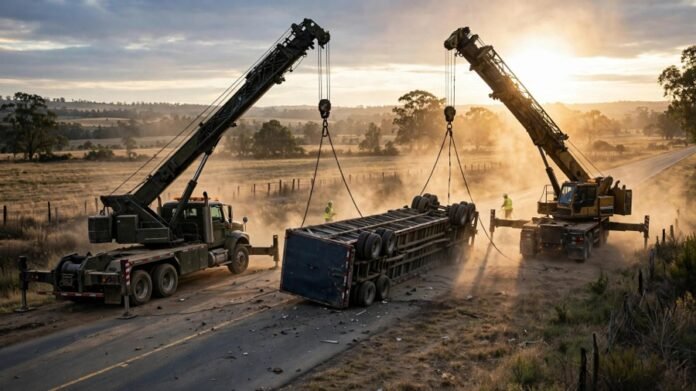
If you ever search High Point heavy towing near me, this is the kind of call that shows why the answer matters. A tractor pulling a refrigerated trailer overturned on an off-ramp near Business 85 and US 29/70 in High Point during a severe storm. The fall tore open part of the trailer’s side, and frozen fish spilled across the ground. Heavy rain, strong wind and thick mud made every step harder, and the smell didn’t help anyone. State Highway Patrol, fire crews and DOT were all on scene. Because the trailer was torn and the load was everywhere, the tractor and trailer couldn’t be recovered as one unit. So the crew split up. Ten team members worked the scene, with one group uprighting the tractor and towing it to the storage yard while another group cleared the fish. They brought a rotator, a 30-ton wrecker, three rollbacks, a skid steer, a dump trailer, a road tractor with a reefer trailer, plus rigging and cribbing. Only once the freight was gone could the WreckMaster-certified operators set up the damaged trailer for its own careful lift. The whole job ran about 16 hours. That number isn’t a sign of a slow crew, by the way. It’s what happens when weather, cargo and a broken trailer all stack up on one scene.
A Loaded Mack on Its Side Outside Asheboro
Now compare that with a job that wrapped up fast. A fully loaded 2016 Mack Granite garbage truck rolled near Pisgah Covered Bridge Road outside Asheboro, and its rear loader popped open on the way over. Household trash covered the road. Worse, hydraulic fluid was leaking from the truck, and a small amount of fuel had spilled into the ditch. The NC State Highway Patrol, the Ulah Fire Department and Randolph County Environmental Services all responded. Six crew members arrived with the Dominator rotator, the hazmat mitigation truck, a medium-duty rollback, a skid steer and a dump trailer. The service truck got to work on the leaking fluids first, containing them before anything else moved. Then came the rigging, and here’s a detail that’s easy to miss: the crew set two doubled main lines and two doubled catch lines. The main lines pull the truck up. The catch lines hold it back as the weight rolls over center, so it doesn’t crash onto its wheels and bounce. Rain had already made the road slick, which made that control even more important. After the Mack was upright, the skid steer cleared the garbage into a trailer for proper disposal, and the ditch was cleaned and covered with fresh dirt. From arrival to cleanup, it took about two hours. So if you’re searching Asheboro heavy towing near me, that’s the standard worth expecting.
What Those Two Jobs Have in Common
The two calls look very different, one long and messy and one quick, but they follow the same rules. These are the lessons that carry over to your truck.
Cargo and Fluids Come Before the Upright
In both cases, the crew dealt with what spilled before it finished with the truck. The fish had to come off before the reefer could be lifted, and the hydraulic fluid and fuel were contained before the Mack moved an inch. That’s why, when you call, you should say exactly what you’re hauling and whether anything is leaking. Mention the type of load, whether it’s refrigerated, and any smell of fuel. Those details tell dispatch to send cleanup gear and hazmat help with the first trucks, instead of an hour later.
Control Matters as Much as Pulling Power
A big rotator can move almost anything, but pulling isn’t the hard part. The hard part is keeping a loaded truck steady as it comes back onto its wheels, which is exactly why the catch lines and cribbing showed up in both stories. In my view, that kind of control is what separates a recovery that adds damage from one that doesn’t. So if a company only talks about how much its truck can lift, ask how it controls the load on the way down.
Greensboro and Winston-Salem: Same Crew, Longer Drive
Both rollovers happened close to home, but the crew covers the whole Triad around the clock. A Greensboro heavy towing near me call usually comes from I-40, I-85, the shared stretch where those two run together, or the I-840 loop, which means fast traffic and very little room on the shoulder. A Winston Salem heavy towing near me search often comes from farther west along I-40, US-52 or US-421. The equipment and training are the same in both cities. What changes is the drive, because the yards sit in Randleman and High Point on US-311, and Winston-Salem is the farthest of the four cities from them. That’s why a clear location helps more out there than anywhere else. Give your road, direction, nearest exit, and a landmark if you can see one. Then add your load, your weight and whether you’re blocking lanes. On a long run, those details let the crew plan the job while they drive, so they get to work the minute they arrive.
Who Shouldn’t Expect a Rotator at Their Door
Real talk: not every breakdown needs this level of equipment. If your car or pickup just quit, a flatbed or rollback is the right call, and the company handles those too. If your semi simply won’t start, a roadside service or diesel repair visit may fix it without any tow. There’s also one honest limit to plan for. The trucks run 24/7, holidays included, but office and release hours are 8 a.m. to 5 p.m., Monday through Friday, so a truck towed to the yard on a Friday night may sit until Monday. The website doesn’t post prices either, since every heavy job is different, so ask for an estimate on the first call. And if you’re far outside the Triad, a closer crew will almost always reach you faster.
What to Remember When It’s Your Truck
Heavy recovery feels chaotic from the shoulder, but good crews follow a clear order. They make the scene safe, contain the fluids, clear the cargo, rig for control, and only then lift. Help them by calling with your exact location, your load, your weight and anything that’s leaking. Expect cleanup to be part of the job, because the road isn’t open until it’s clean. Whether you’re in Randleman, Asheboro, High Point, Greensboro or Winston-Salem, the same certified crew and the same Dominator rotator can respond, day or night. Save (336) 498-2503 now, while your truck is still running fine.
Heavy Recovery Questions, Answered
How do tow trucks flip an overturned semi back over?
Crews rig a rotator or heavy wrecker with main lines to pull the truck up and catch lines to control it as it rolls onto its wheels. They often use cribbing or air cushions to support the load during the lift.
How long does a heavy truck recovery take?
A simple upright can take about two hours, while a torn trailer with spilled cargo in bad weather can take 16 hours or more. Weather, cargo, fluid leaks and trailer damage all change the timeline.
Who cleans up spilled cargo after a truck rollover?
The recovery company often clears the cargo with skid steers and trailers, working alongside fire, highway patrol and environmental agencies. Fluid leaks are contained before or during the recovery so the road can open safely.
What is a rotator tow truck used for?
A rotator has a boom that swings like a crane, so it can lift a truck from the side or at an angle. That makes it the main tool for rollovers and recoveries in tight spaces.
Can a tractor and trailer be recovered separately?
Yes, crews often recover the tractor first and handle the trailer later when it’s damaged or still loaded. Splitting the work lets the road clear faster and makes each lift safer.