
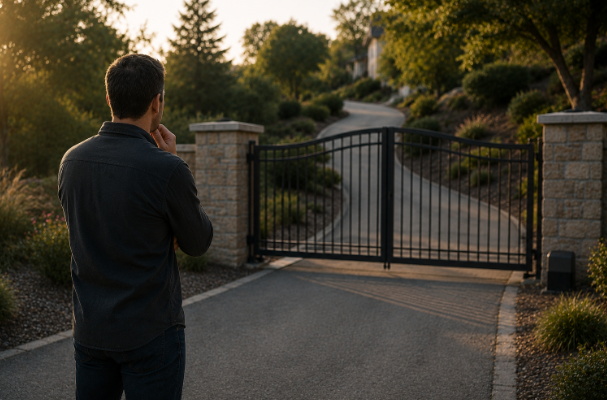

People tend to pick a driveway gate the way they pick a front door, by how it looks. The property picks it first. The slope of the driveway, its length, the room to either side, and where the electrical power runs all decide what will actually work, long before the style of the ironwork enters the conversation.
Swing or Slide Is the First Fork
Most driveway gates open one of two ways, and the choice is rarely about taste. A swing gate needs level ground and a clear arc to travel through, which suits a flat driveway with space to spare. A slide gate moves sideways along the fence line, so it works where the ground rises, the driveway is short, or a swinging gate would open into a slope. The geometry of the entrance usually settles the question before anyone weighs in on the look. A gate forced onto the wrong driveway drags, binds, or stops closing properly within a season or two.
The Ground Decides Its Lifespan
A gate is only as steady as what holds it up. Heavy steel is heavy, and a gate hung on undersized posts or shallow footings will sag, drift, or hang crooked over time as the ground shifts. Getting the foundation right is the part nobody sees:
- Posts sized to the weight and span of the gate
- Concrete footings set deep enough for stability
- Drainage that keeps water from undermining the posts
- Level, stable ground along the full path of a slide gate
Companies that handle Driveway Gate Installation in the Dallas Fort Worth Metroplex size that foundation to the gate and the soil rather than to a standard spec. In the expansive clay soils common across the Metroplex, which swell and shrink with the seasons, that footing work matters even more, since ground that moves will move a gate along with it.
Power and Automation Belong in the Plan Early
The most common regret is treating automation as an afterthought. An automated gate is a small system: an opener sized to the gate’s weight, safety sensors that stop it against an obstruction, and an access method, a keypad, a remote, or phone control. All of it runs on power, and the conduit for that power is far cheaper to run before the driveway is paved than to trench in afterward. A crew that plans the electrical path alongside the gate itself leaves the automation ready to connect, rather than retrofitted into finished concrete later.
Built for the Texas Climate
Steel in North Texas takes heat, sun, and the occasional hard freeze, and the finish is what carries it through. A properly prepared and coated gate resists rust and holds up to the swings in temperature, while a rushed finish wears fast. Fabricators with long roots in the area tend to build to the local climate and coordinate with builders so a gate fits the property and the schedule rather than fighting both.
A driveway gate looks like a style decision, and the style does matter. What decides if it still opens smoothly in ten years is the ground it stands on, the way it moves, and the planning done before the first post goes in.

