
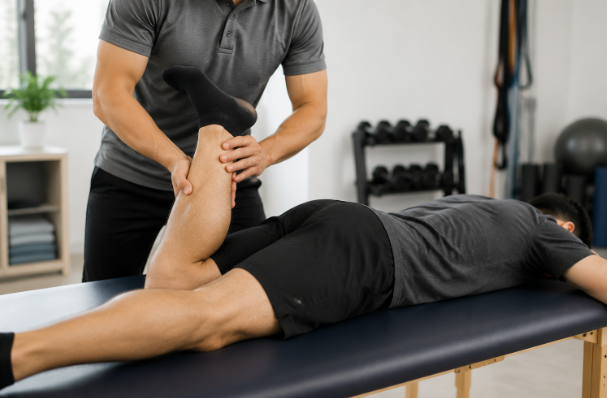

Manual therapy is usually filed under injury treatment, something an athlete seeks out after something starts to hurt. That is one use of it, and not the only one. A restriction that has not become painful can still be holding an athlete back, and hands-on work has a role to play before anything actually goes wrong.
A Restriction Can Be Silent
A joint or muscle that has lost part of its range often does not hurt. The body is good at compensating, so it borrows the missing motion from somewhere else and carries on, and the athlete never registers a problem. What they might notice, without connecting it, is a ceiling. A hip that cannot fully extend shortens a sprint stride. A stiff upper back limits how well an overhead lift can be set up. There is no pain to point to, just a level the athlete cannot seem to get past, and a restriction sitting quietly underneath it.
Range Is Raw Material for Performance
Movement an athlete does not have is movement they cannot train or use. A joint that moves through its full range gives the surrounding muscles more to work with, while a restricted one limits how much force can be produced and where. Restoring lost range does not automatically make an athlete stronger, but it removes a limit that strength training alone will not fix, since a muscle cannot pull a joint through a range the joint will not go. This is part of what Manual Therapy for Athletes addresses, returning motion to a joint or tissue so that training has more to build on.
The Assessment Catches What Athletes Miss
Hands-on work is also a way of finding these limits before they matter. A practitioner assessing an athlete can feel where mobility is reduced and where one side moves differently from the other, and those asymmetries are worth catching early:
- A joint that has lost range on one side but not the other
- Tissue that stays guarded or tight under repeated loading
- Compensations left behind by an old injury that healed unevenly
Left unaddressed, these are the small imbalances that tend to become the next injury.
Upkeep, Not Only Repair
This is why some athletes use hands-on work as maintenance rather than waiting for a breakdown. Repetitive training loads the same patterns over and over and slowly builds restrictions, and periodic attention keeps the body moving well and can lower the odds of the next setback. Practitioners who work with athletes tend to treat manual therapy as one part of staying ready rather than only a response to pain. The aim is to keep an athlete ahead of the problem instead of chasing it after it lands. Anyone with a specific injury or ongoing symptoms should still be assessed in person by a qualified professional, since the right plan depends on the individual.
Pain is the obvious reason to seek treatment, and it is not the only one. For an athlete, the range a joint slowly gives up is a limit worth addressing before it turns into a plateau, or into the injury that finally makes it impossible to ignore.

