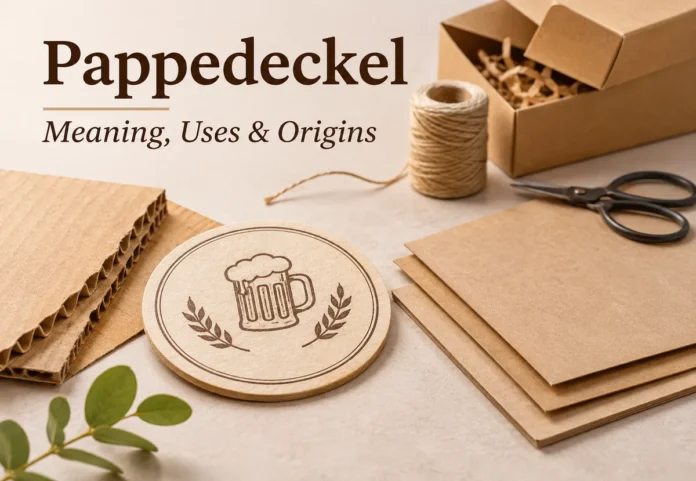
Pappedeckel is a German expression associated with cardboard, paperboard, and pieces of stiff paper-based material. It appears in regional German vocabulary and relates closely to the standard German words Pappdeckel and Pappendeckel. Depending on the context, it can describe a piece of cardboard, a protective cover, or a flat paperboard component. The word also has interesting connections with traditional German beer coasters, packaging, bookbinding, and everyday household objects.
Understanding Pappedeckel requires looking at both its linguistic background and practical meaning. Although its individual parts suggest a cardboard lid, the expression has a broader connection with cardboard materials.
What Does Pappedeckel Mean in German?
The word Pappedeckel combines two German elements: Pappe, meaning cardboard, and Deckel, meaning lid or cover. Together, they suggest a cardboard cover or a piece of stiff paper-based material.
However, the meaning depends on how someone uses the expression. In some regional German dialects, Pappedeckel refers to cardboard itself rather than a manufactured lid. This distinction helps explain why English translations include cardboard, cardboard sheet, paperboard, and cardboard cover.
Pappedeckel vs. Pappdeckel and Pappendeckel
German has several closely related spellings that can confuse people learning the language. Pappdeckel and Pappendeckel are established standard German forms, and both describe a piece of cardboard.
Pappedeckel appears in Alemannic regional vocabulary, particularly in southwestern German speech. Related regional spellings include Pabbedeggel and Babbedeckel. Therefore, Pappedeckel is not simply a random spelling variation, although the standard forms are more appropriate in formal German writing.
The Historical Meaning of Pappe
The German word Pappe has an interesting linguistic background. Its material-related meaning developed from an older word associated with mush or soft mixtures, reflecting the wet paper fibers used in traditional papermaking.
During the 18th century, Pappe became established as a name for thick paper-based material. Bookbinders used several layers of paper to produce stiff boards for book covers and other protective structures. This historical connection helps explain why Pappendeckel became associated with rigid cardboard.
How Pappedeckel Is Used in Everyday Life
Cardboard materials appear in many ordinary activities, from packaging household products to creating handmade decorations. Their usefulness comes from their relatively low weight, adaptable shape, and ability to provide a firm supporting surface.
Packaging and Protective Covers
Manufacturers use cardboard pieces to protect products during storage, handling, and transportation. Flat paperboard sheets can separate individual products, cover compartments, and prevent items from moving inside packaging.
The material also provides a convenient surface for printed instructions, product labels, and branding. Depending on the required protection, manufacturers select different thicknesses and board structures.
Household Storage and Organization
Pappedeckel-related cardboard products can help organize household belongings. People use stiff cardboard covers and sheets for storage boxes, document folders, photo collections, and lightweight organizers.
A properly fitted cover protects stored objects from ordinary dust and handling. However, cardboard works best in dry indoor environments because moisture can soften the fibers and cause the material to lose its original shape.
Arts, Crafts, and Educational Projects
Cardboard is a familiar material in schools, workshops, and creative projects. Students and hobbyists can cut, fold, paint, glue, and decorate it to create models, display boards, picture frames, and handmade packaging.
Thicker paperboard provides a stable base for architectural models and miniature structures. Thinner varieties are easier to cut and shape by hand. These qualities also make cardboard useful for testing a design before producing it from more expensive materials.
Pappedeckel and the History of German Beer Coasters
One interesting connection involves the German Bierdeckel, which means beer coaster or beer mat. This small cardboard disc sits beneath a drinking glass to absorb condensation and protect tables from moisture.
The history of modern cardboard beer coasters goes back to the late 19th century. In 1880, Friedrich Horn’s cardboard factory and printing business in Buckau, near Magdeburg, began producing printed cardboard drink coasters. Robert Sputh later registered a patent for a molded wood-fiber coaster on October 25, 1892.
Why German Pubs Use Bierdeckel
Traditional beer coasters serve practical purposes in restaurants, pubs, and beer gardens. They absorb moisture, protect wooden surfaces, and provide space for brewery logos and advertising.
Some German pubs also use coasters to record customers’ drink orders. Staff can make small marks on the coaster to keep track of the number of drinks served. In outdoor settings, people sometimes place a coaster over a glass to keep dust and insects away.
Is Pappedeckel the Same as Bierdeckel?
No, the two expressions do not describe exactly the same thing. Bierdeckel identifies a specific object used as a drink coaster, whereas Pappedeckel relates more broadly to cardboard and paperboard.
A traditional beer coaster can be made from cardboard, so the terms may overlap when describing its material. However, a cardboard sheet used for bookbinding or packaging is not a Bierdeckel. Understanding this distinction makes German translations and product descriptions more accurate.
Materials and Manufacturing of Pappedeckel
Pappedeckel-related products can use different paper-based materials depending on their intended application. Manufacturers commonly work with virgin wood fibers, recycled paper fibers, or combinations of both.
The manufacturing process generally involves mixing fibers with water, forming sheets, pressing the material, and removing moisture through drying. Additional layers can increase stiffness and produce a stronger board.
Solid Board and Corrugated Cardboard
Two common cardboard structures serve different purposes.
Solid board (Vollpappe) contains compact layers of paper fibers pressed or bonded together. It provides a relatively smooth, firm surface suitable for book covers, protective sheets, packaging inserts, and craft projects.
Corrugated board (Wellpappe) contains a wavy paper layer between flat outer sheets. This construction creates air spaces that improve cushioning and make it useful for shipping cartons and protective packaging.
Thickness, Strength, and Surface Finishing
The thickness of cardboard affects its flexibility, stiffness, and resistance to bending. However, fiber quality, density, moisture content, and construction also influence overall strength.
Manufacturers can use cutting, printing, coating, and lamination to produce different finishes. Die cutting creates consistent shapes, while printing allows businesses to add logos, instructions, and decorative designs.
Environmental Benefits and Recycling Considerations
Paperboard products can support more responsible packaging when manufacturers use recycled fibers and appropriate production methods. Their lightweight construction can also reduce material requirements in certain applications.
However, not all cardboard products have the same environmental characteristics. Plastic coatings, adhesives, inks, and food contamination can affect whether a particular item qualifies for ordinary paper recycling.
Clean and uncoated cardboard generally offers straightforward recycling options. Consumers should check local waste collection instructions before disposing of coated or contaminated products.
Reusing suitable cardboard can also extend its useful life. Storage dividers, craft materials, and protective packaging can often serve additional purposes when the material remains clean and structurally sound.
How to Choose the Right Pappedeckel Product
Selecting the right cardboard product starts with understanding its intended purpose. A coaster requires different properties from a protective packaging insert or a rigid book cover.
Before purchasing, consider the required dimensions, thickness, material composition, and surrounding conditions. For example, a product exposed to moisture may need a suitable protective coating, while a packaging component may require greater stiffness.
For commercial orders, request a sample and check its dimensions and performance before buying in bulk. Businesses should also confirm food-contact suitability when the material will touch unpackaged food. These simple checks help prevent problems with product quality, handling, and disposal.
Conclusion
Pappedeckel is an interesting German expression with connections to cardboard materials, regional language, traditional manufacturing, and everyday products. Its meaning extends beyond a simple cardboard lid and includes references to pieces of stiff paperboard used in packaging, storage, crafts, and other applications.
Its relationship with Pappdeckel, Pappendeckel, and Bierdeckel also reveals interesting differences in German vocabulary. Understanding these distinctions makes it easier to interpret the word correctly, choose suitable cardboard products, and appreciate the history of traditional paper-based materials.
Frequently Asked Questions
1. What is the English translation of Pappedeckel?
Pappedeckel generally translates as cardboard, a piece of cardboard, or a cardboard cover, depending on its regional usage and the context.
2. Is Pappedeckel a real German word?
Yes, Pappedeckel appears in documented Alemannic regional vocabulary, while Pappdeckel and Pappendeckel are established standard German spellings.
3. What is the difference between Pappedeckel and Pappendeckel?
Pappedeckel is a regional German form, while Pappendeckel is a standard spelling that describes a piece of stiff cardboard material.
4. Does Pappedeckel mean a beer coaster?
Not specifically, although cardboard beer coasters are related products; the standard German word Bierdeckel specifically identifies a coaster placed beneath drinking glasses.
5. Can Pappedeckel refer to a driving license?
Yes, certain Alemannic dialects use related expressions for a driving license, making regional context essential when interpreting the word.
6. Is Pappedeckel environmentally friendly?
It can offer environmental advantages when manufacturers use responsibly sourced or recycled fibers, minimize coatings, and design products for suitable recycling systems.
7. Can Pappedeckel be used for food packaging?
Yes, specially manufactured paperboard products can serve food packaging applications when their materials and production meet the applicable food-contact requirements.