
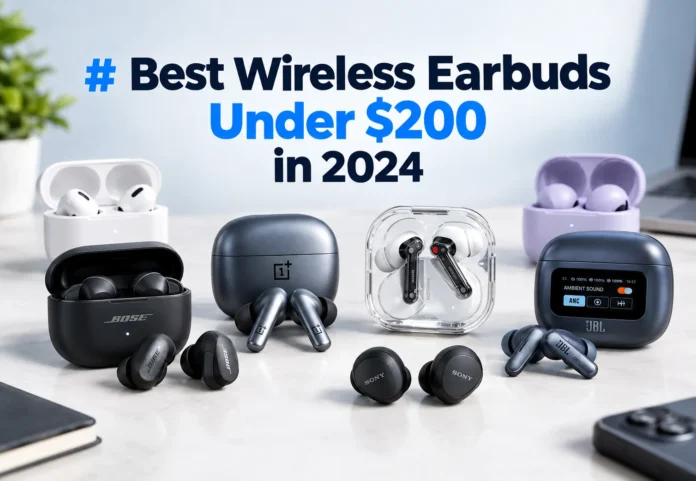

The best wireless earbuds under $200 in 2024 offer premium features without flagship prices. Strong options now combine good sound quality with active noise cancellation and long battery life. Bluetooth earbuds also offer multipoint Bluetooth, transparency mode, and useful companion apps. Many models support wireless charging, fast charging, and adjustable EQ settings.
Buyers can choose models designed for iPhone, Android, Samsung Galaxy, workouts, commuting, or travel. Fit and ear-tip design still affect comfort, passive isolation, and ANC performance. Water resistance and IP ratings also matter for exercise and outdoor use. This guide compares true wireless earbuds using a practical user journey.
Best Wireless Earbuds Under $200 in 2024: Quick Picks
Nothing Ear (2024) – Best Overall
Nothing Ear (2024) offers a balanced mix of sound, features, and customization. Its 11 mm driver supports detailed playback and 24-bit Hi-Res Audio. Nothing rates its ANC system for noise reduction reaching 45 dB.
The Nothing X app provides extensive EQ controls and sound customization. Transparency mode keeps surrounding sounds audible when needed. Multipoint connectivity, called Dual Connection, helps users switch between two devices. Wireless charging adds another useful premium feature.
Battery life reaches 8.5 hours with ANC disabled. The charging case raises total playback to 40.5 hours. Nothing also offers fast charging for short top-ups.
Its original launch price was $149. Current prices can be considerably lower. That combination makes Nothing Ear a strong all-round option.
OnePlus Buds 3 – Best Value
OnePlus Buds 3 targets buyers wanting strong features near $99.99. Its dual-driver system uses BassWave enhancement for a fuller low end. Adjustable EQ also gives listeners more control over the bass-forward tuning.
Active noise cancellation reaches a claimed 49 dB. Transparency mode provides environmental awareness without removing the earbuds. Multipoint connects two devices for easier switching. Touch volume controls sit directly on the stems.
Battery life reaches 10 hours with ANC disabled. The charging case extends playback to 44 hours. With ANC enabled, those figures become 6.5 and 28 hours. Fast charging also reduces downtime.
IP55 protection suits exercise and light rain. Android users also get LHDC 5.0 support on compatible devices. The combination makes these especially compelling for value-focused Android buyers.
Bose QuietComfort Earbuds – Best Noise Cancellation
Bose QuietComfort Earbuds launched in 2024 at $179. Their main strength is active noise cancellation for noisy environments. Bose combines ANC with a sealed in-ear design and stability bands.
That passive sealing helps reduce outside sound before ANC begins working. It makes the earbuds useful on airplanes and trains. They also suit commuting and noisy offices.
Bluetooth multipoint allows switching between connected devices. The six-microphone system handles ANC and voice pickup. Bose gives the earbuds an IPX4 water-resistance rating.
Battery life reaches 8.5 hours per charge. The wireless charging case stores another 2.5 charges. These strengths make Bose attractive when noise reduction matters most.
AirPods 4 with ANC – Best for iPhone
Apple AirPods 4 with ANC integrate closely with the iPhone and iOS. Apple’s H2 chip powers Active Noise Cancellation and Adaptive Audio. Transparency mode keeps environmental sounds available when required.
Personalized Spatial Audio adds dynamic head tracking. Voice Isolation improves speech during supported calls. Conversation Awareness can also adjust listening automatically.
The open design avoids silicone ear tips. This can feel more natural for people disliking sealed earbuds. However, weaker physical isolation limits sub-bass and ANC effectiveness.
Battery life reaches four hours with ANC enabled. The USB-C charging case raises ANC listening to 20 hours. With noise control disabled, the earbuds reach five hours.
Apple originally priced this ANC model at $179. Fast pairing and device switching strengthen its Apple ecosystem appeal.
Sony WF-C710N – Best ANC Alternative
Sony WF-C710N provides ANC without entering Sony’s flagship price tier. The design combines active cancellation with passive isolation from silicone ear tips. Adaptive Sound Control can adjust listening behavior for different environments.
Sony’s Sound Connect app provides EQ customization and ambient noise controls. Bluetooth 5.3 supports modern wireless connectivity. SBC and AAC handle standard Bluetooth audio.
Multipoint Bluetooth lets Android users maintain connections with two compatible devices. The earbuds also carry an IPX4 rating. That protects against splashes and sweat during normal use.
Battery life approaches nine hours with noise cancellation active. The charging case brings total listening near 30 hours. Market pricing can fall near $89 from the $129.99 list price.
Some premium Sony models support LDAC. WF-C710N does not offer LDAC or aptX. Buyers wanting those codecs should consider alternatives.
JBL Live Beam 3 – Best Battery Life
JBL Live Beam 3 combines long battery life with an unusual smart charging case. Its 1.45-inch touchscreen controls playback without opening a phone app. It can also manage calls and several earbud settings.
Battery life reaches 12 hours with ANC disabled. The case adds another 36 hours, creating 48 hours total. Wireless charging and speed charging provide flexible power options.
True Adaptive ANC handles changing environmental noise. Ambient Aware provides a transparency-style listening mode. Multipoint support also improves use between work and personal devices.
Six microphones support calls. IP55 protection covers dust and water exposure. JBL also supports Hi-Res Audio Wireless and LDAC.
Prices have ranged around $129.95 to the original $199.95 level. Strong battery life remains the clearest reason to choose them.
Jabra Elite 8 Active – Best for Workouts and Running
Jabra Elite 8 Active focuses on fitness, durability, and secure fit. Jabra ShakeGrip improves stability without requiring large ear hooks. The grippy finish helps during running and gym sessions.
Its IP68 rating provides strong dust and water resistance. Jabra also uses military-standard durability testing. The charging case carries its own protection rating.
Adaptive Hybrid ANC reduces environmental noise during workouts. HearThrough provides awareness when running near roads. The design therefore balances isolation with outdoor safety needs.
Battery life reaches eight hours with ANC active. Total battery life reaches 32 hours with the case. Disabling ANC increases those figures to 14 and 56 hours.
Pricing has reached the $199.99 ceiling. Fitness users gain more value from its ruggedness than casual listeners.
Creative Aurvana Ace 3 – Best for Sound Quality
Creative Aurvana Ace 3 uses an unusual hybrid driver system. Each earbud combines an xMEMS solid-state driver with a 10mm dynamic driver. The design separates parts of the frequency range between different driver technologies.
Mimi Sound Personalization adapts playback to individual hearing profiles. Codec support includes aptX Lossless and LDAC. AAC, SBC, LC3, and aptX Adaptive are also available.
The earbuds support ANC and an ambient listening mode. Three MEMS microphones sit inside each earbud. Bluetooth 5.4 handles wireless connectivity.
Battery life reaches seven hours per charge with ANC disabled. The case raises total playtime to 26 hours. A ten-minute charge provides another 75 minutes.
Its $149.99 class makes advanced audio technology more accessible. MDAQS-style sound assessments can help compare performance. However, fit and personal preference still affect perceived sound.
Best Wireless Earbuds Under $200 Compared
Specifications reveal major differences between earbuds sharing the same price bracket. ANC strength, battery life, and water resistance can vary widely. Ecosystem features also change the experience across iPhone, Android, and Samsung devices.
| Earbuds | Typical/List Price | Battery With Case | Water Resistance | Key Strength |
| Nothing Ear (2024) | $149 launch | 40.5 hours, ANC off | IP54 earbuds | Balanced features |
| OnePlus Buds 3 | $99.99 class | 44 hours, ANC off | IP55 | Value |
| Bose QuietComfort Earbuds | $179 launch | 8.5 hours per charge | IPX4 | ANC |
| AirPods 4 with ANC | $179 launch | 20 hours, ANC on | Dust, sweat, water resistant | iPhone integration |
| Sony WF-C710N | $129.99 list | About 30 hours | IPX4 | Affordable ANC |
| JBL Live Beam 3 | $199.95 list | 48 hours, ANC off | IP55 | Battery and smart case |
| Jabra Elite 8 Active | Under $200 on sale | 32 hours, ANC on | IP68 | Workouts |
| Creative Aurvana Ace 3 | $149.99 class | 26 hours, ANC off | IPX5 | Advanced codecs |
Nothing Ear offers wireless charging and strong sound customization. OnePlus Buds 3 favors Android users seeking lower prices. JBL Live Beam 3 combines multipoint with its touchscreen charging case.
Samsung Galaxy Buds FE remain another affordable choice. They support ANC and Samsung Auto Switch. Their IPX2 protection is weaker than fitness-focused alternatives.
Detailed Reviews of the Best Wireless Earbuds Under $200
Nothing Ear (2024)
Nothing Ear uses an 11 mm ceramic driver for sound reproduction. The design supports Hi-Res Audio and LDAC. Its sound can be reshaped through the Nothing X app.
Nothing provides an advanced eight-band equalizer rather than only basic 3-band EQ. A parametric-style advanced equalizer allows more precise adjustments. Personal Sound Profile adds another route for sound customization.
ANC reaches a claimed 45 dB. Transparency mode handles situations requiring outside awareness. Multipoint connectivity appears as Dual Connection inside Nothing’s feature set.
Battery life reaches 8.5 hours without ANC. The charging case expands playback to 40.5 hours. Wireless charging makes daily charging easier.
At its original $149 price, Nothing Ear competed with premium midrange models. Its broad feature set remains its biggest advantage.
OnePlus Buds 3
OnePlus Buds 3 combine dual dynamic drivers with BassWave enhancement. Their tuning emphasizes energetic bass without removing EQ control. Android users can access Hi-Res Audio through supported configurations.
The HeyMelody app handles adjustable EQ and other settings. Stem gestures provide touch volume controls. Transparency mode offers awareness outside ANC listening.
OnePlus claims ANC reaching 49 dB. Bluetooth 5.3 supports stable wireless connections. Dual Connection provides multipoint between two devices.
IP55 protection suits workouts and rainy conditions. Battery life reaches 10 hours without ANC. The case increases total playback to 44 hours.
ANC lowers those figures to 6.5 and 28 hours. A ten-minute charge can restore several hours of listening. These features are unusually broad around $99.99.
Bose QuietComfort Earbuds
Bose designed its 2024 QuietComfort Earbuds around everyday noise cancellation. Three microphones sit inside each earbud. Together, six microphones support ANC and voice pickup.
The sealed design provides useful passive isolation. Stability bands improve fit without conventional ear wings. Three eartip sizes help create the required seal.
Bluetooth 5.3 supports multipoint connections. Call quality benefits from the multi-microphone arrangement. IPX4 protects against sweat and light water exposure.
Each charge provides up to 8.5 hours. The wireless charging case stores 2.5 additional charges. A 20-minute charge adds up to three hours.
The $179 launch price placed Bose below many flagship ANC earbuds. Commuters gain the most from its noise-focused design.
Apple AirPods 4 with ANC
AirPods 4 place Apple’s H2 chip inside an open-fit design. ANC works without traditional silicone ear tips. That makes their approach unusual among noise-cancelling earbuds.
Adaptive Audio changes noise control based on surrounding conditions. Transparency mode preserves environmental awareness. Conversation Awareness can reduce listening interference during conversations.
Personalized Spatial Audio supports dynamic head tracking. Voice Isolation improves supported calls. Fast pairing makes setup simple across compatible Apple devices.
ANC listening lasts four hours per charge. The USB-C charging case raises that figure to 20 hours. Noise control off increases totals to five and 30 hours.
The open design provides less passive isolation than sealed earbuds. That can reduce sub-bass impact in noisy places. Apple’s ecosystem features remain the strongest reason to choose them.
Sony WF-C710N
Sony WF-C710N brings the company’s ANC tools to a lower price. Silicone ear tips create passive isolation before electronic cancellation begins. A proper seal also improves bass consistency.
Adaptive Sound Control changes settings around different activities. Sony’s Sound Connect app provides EQ customization. Ambient sound mode keeps surroundings audible when needed.
Bluetooth 5.3 handles wireless connections. Multipoint Bluetooth allows connections to two compatible devices. SBC and AAC are the supported standard codecs.
IPX4 protection handles sweat and splashes. Battery life reaches roughly nine hours with ANC. The case pushes total listening toward 30 hours.
The model has appeared near $89 during discounts. Its list price sits around $129.99. Buyers should not expect LDAC or aptX support here.
JBL Live Beam 3
JBL puts a touchscreen directly into the Live Beam 3 smart charging case. It can control playback, calls, and several settings. That reduces dependence on the JBL Headphones app.
True Adaptive ANC changes cancellation based on surrounding noise. Ambient Aware works as the transparency option. Studio-style EQ presets can adjust bass and treble.
Multipoint keeps two devices available. LDAC adds higher-bitrate audio on compatible hardware. Wireless charging improves convenience at a desk.
Six microphones support voice calls. The IP55 rating adds dust and water protection. Comfort still depends on choosing the correct ear-tip size.
Battery life reaches 12 hours without ANC. The case provides 48 hours total. Pricing has ranged between about $129.95 and $199.95.
Jabra Elite 8 Active
Jabra Elite 8 Active prioritizes stability over fashionable design. ShakeGrip helps keep each earbud secure during movement. It avoids large external ear wings.
The IP68 rating offers substantial water and dust protection. Military-standard testing covers demanding environmental conditions. This durability suits regular outdoor exercise.
Adaptive Hybrid ANC adjusts to surrounding noise. HearThrough restores environmental awareness. This is useful during outdoor running and fitness sessions.
Battery life reaches eight hours with ANC. The charging case increases that to 32 hours. Without ANC, playback reaches 14 hours and 56 hours total.
Its original pricing approached $199.99. The value depends heavily on needing durability and secure fit.
Creative Aurvana Ace 3
Creative Aurvana Ace 3 uses two different driver technologies. An xMEMS solid-state unit handles part of the audio reproduction. A 10mm dynamic driver complements it.
Mimi Sound Personalization adapts playback to the listener. AptX Lossless supports compatible Snapdragon Sound hardware. LDAC provides another high-resolution wireless option.
The codec list also includes AAC and SBC. LC3 and aptX Adaptive expand device compatibility further. Bluetooth 5.4 manages the wireless connection.
ANC handles environmental noise. Ambient mode restores outside sound when required. Each earbud also contains three omnidirectional MEMS microphones.
Battery life reaches seven hours without ANC. Total playback reaches 26 hours through the charging case. The $149.99 price class keeps these below $200.
How We Evaluate Wireless Earbuds Under $200
Sound Quality and Sound Signature
Sound quality starts with frequency response and tuning. Bass should have weight without covering vocals. Midrange clarity keeps speech and instruments easy to follow.
Treble detail should remain clear without becoming harsh. A balanced sound often suits more music styles. Warm sound can favor listeners wanting richer low frequencies.
EQ can correct an unwanted sound signature. MDAQS and preference curves offer structured comparison methods. Hi-res wireless audio also depends on compatible codecs and source devices.
Active Noise Cancellation and Passive Isolation
ANC uses microphones and processing to reduce external noise. It often works best against steady low-frequency noise. Aircraft engines and office HVAC systems are good examples.
Passive isolation comes from the physical seal. Silicone ear tips can reduce outside noise before ANC starts. A poor fit weakens both isolation and bass.
Transparency mode does the opposite. It feeds useful ambient noise back into the earbuds. This helps around traffic, buses, and trains.
Microphone and Call Quality
Microphone quality depends on more than microphone count. Wind and traffic can overwhelm weak voice-processing systems. Background noise creates similar problems indoors.
MEMS microphones are common in modern earbuds. Some systems combine them with Voice Isolation algorithms. Clear calls require both useful hardware and effective processing.
Outdoor recording provides a tougher test than quiet rooms. Artificial-mouth testing can make comparisons more repeatable. Real calls still reveal practical weaknesses quickly.
Comfort, Fit and Long-Term Wear
Fit changes sound, isolation, and comfort simultaneously. Silicone ear tips should seal without creating excessive ear pressure. Several ear-tip sizes improve the chance of proper fit.
Stability bands and flexible wing tips help during movement. Ear wings can provide extra security during workouts. Open designs may feel less intrusive.
Sealed designs usually provide stronger passive isolation. An ear-tip fit test can help find leaks. Long listening sessions make small comfort problems more noticeable.
Battery Life and Charging
Battery claims need context. ANC-on figures are usually lower than advertised maximum playback. High volume and demanding codecs can also shorten battery life.
The charging case determines total battery endurance. Earbud-only battery matters more during long uninterrupted sessions. Fast charging helps when only minutes are available.
Wireless charging improves desk-side convenience. USB-C remains the common wired option. Battery aging eventually reduces maximum capacity.
Charging habits and temperature also affect lithium battery health. Extreme heat can accelerate degradation. Real playback therefore varies from laboratory claims.
Bluetooth, Multipoint and Audio Codecs
Bluetooth carries audio between earbuds and the source device. Bluetooth 5.3 appears on many current midrange models. Newer products may use Bluetooth 5.4.
Multipoint Bluetooth keeps two devices connected simultaneously. This simplifies switching between a laptop and phone. Dual-device connection is especially useful during work.
SBC and AAC provide broad compatibility. Android devices may also support LDAC or LHDC. AptX and aptX Lossless require compatible hardware.
Codec compatibility matters more than the logo alone. Unsupported phones fall back to another Bluetooth audio codec. Multipoint behavior can also vary between devices.
Durability and Water Resistance
IP ratings describe protection against dust and water. IPX4 generally covers sweat and splashes. IP55 adds rated dust protection alongside water resistance.
IP68 provides much stronger environmental protection. Jabra Elite 8 Active uses this rating. It also underwent military-standard durability testing.
Water resistance does not automatically mean swimming support. Manufacturers define allowed water exposure separately. Protection levels should match the intended exercise.
Apps, EQ and Software Support
A companion app can extend an earbud’s useful life. Firmware updates may fix bugs or improve controls. They can also add listening modes.
EQ gives users control over sound customization. Some apps provide simple 3-band EQ controls. Others offer advanced or parametric equalizers.
Nothing X provides extensive sound controls. Sony uses its Sound Connect app. Beats and other ecosystem products use different software approaches.
Cloud presets can simplify switching sound profiles. Custom controls also reduce unnecessary phone use. Good software should make hardware easier to use.
How Wireless Earbuds Are Tested
Repeatable testing helps separate specifications from actual performance. Frequency response can be measured with a head-and-torso simulator. Systems such as Bruel & Kjaer 5128 approximate human ear acoustics.
HATS equipment includes an anatomically realistic ear canal. Measurements can approximate sound reaching the eardrum. A SoundGuys Preference Curve can provide a comparison target.
Noise tests can use controlled signals around 90dB SPL. Playback measurements may use levels near 75dB SPL. A real-time analyzer records frequency and level changes.
ANC and isolation need separate measurements. Noise-shaping signals help test performance across frequencies. A controlled test chamber improves consistency.
Microphone quality can use an artificial mouth. Objective tests then complement subjective measures. Standardized testing makes comparisons easier across different earbuds.
Real-world testing remains useful for comfort and controls. It also exposes connection problems missed by bench measurements. Both approaches give a more complete picture.
How to Choose the Right Wireless Earbuds Under $200
Prioritize Sound Quality and EQ
Start with the sound signature rather than codec marketing. Balanced sound generally keeps bass, vocals, and treble detail proportionate. Bass-heavy sound adds impact but can mask midrange detail.
Warm sound softens the presentation. Detailed sound places greater focus on clarity. EQ and sound customization can reshape either approach.
Frequency response offers useful technical context. Personal preference still decides what sounds enjoyable. Adjustable EQ therefore adds meaningful long-term value.
Decide How Much ANC You Actually Need
Strong ANC matters most in consistently noisy places. Commuting and travel create clear benefits. Airplanes and trains produce steady noise that ANC handles well.
Passive noise isolation also matters. Ear tips create the physical seal needed for good performance. Weak sealing reduces both noise reduction and bass.
Buyers in quiet spaces may need less ANC. Better sound or comfort may provide more value instead. Usage should determine the priority.
Check Fit and Comfort Before Features
Fit can make expensive earbuds perform poorly. Correct ear-tip sizes improve comfort and acoustic sealing. Stem design also changes weight distribution.
Wingtips and stability bands improve security during movement. Sealed construction usually strengthens isolation. Open construction reduces the plugged-ear feeling.
Excessive ear pressure can become tiring. A secure fit should not require constant adjustment. Comfort matters most during long listening sessions.
Compare Real Battery Life and Charging Options
Compare ANC-on battery life before maximum marketing claims. Earbud-only battery determines uninterrupted listening time. Total battery includes the charging case.
Fast charging helps commuters and travelers. Wireless charging is convenient but not essential. USB-C charging remains widely available.
Playback time changes with volume and features. Advanced codecs can consume additional power. Compare battery figures under similar conditions.
Check Bluetooth Codecs and Multipoint
SBC and AAC work across many devices. LDAC and LHDC mainly target compatible Android hardware. AptX Lossless needs supported source hardware.
Multipoint Bluetooth improves device switching. It can keep a phone and laptop connected together. This reduces repeated pairing during work.
Codec compatibility should match the actual phone. A premium codec provides no benefit when unsupported. Bluetooth audio will simply use another available codec.
Match Water Resistance to Your Use
IPX4 is enough for many ordinary workouts. IP55 adds useful dust protection. IP68 better suits demanding outdoor activity.
Sweat protection matters for regular exercise. Running also requires a secure physical fit. Water exposure beyond rated limits can still damage electronics.
Swimming requires explicit manufacturer support. A high IP rating alone should not imply swimming suitability. Check the stated protection level before water use.
Check App, Firmware and Ecosystem Support
Companion apps control EQ and listening modes. Firmware updates can improve stability and features. Custom controls also make daily use faster.
Apple ecosystem products integrate closely with iOS. Samsung ecosystem models can use Auto Switch. Android models may expose broader codec choices.
Ecosystem integration can outweigh small specification differences. Check features on the phone actually being used. Some functions disappear outside the native platform.
Best Earbuds Under $200 by Phone Ecosystem
Best for iPhone and Apple Devices
AirPods 4 provide the smoothest Apple ecosystem experience. The H2 chip supports Adaptive Audio and Spatial Audio. Device switching and fast pairing work naturally with iPhone.
Beats Fit Pro use Apple’s H1 chip. They add flexible wing tips and an ear-tip fit test. ANC and transparency support everyday and workout use.
Both options work with iOS. AirPods favor open-fit comfort. Beats Fit Pro provide stronger physical sealing.
Best for Android Phones
OnePlus Buds 3 offer strong value for Android. LHDC support provides higher-resolution audio on compatible hardware. Multipoint also improves device switching.
Nothing Ear supports LDAC and detailed sound customization. Its companion app works across many Android devices. The advanced EQ provides unusually deep control.
Creative Aurvana Ace 3 supports aptX Lossless and LDAC. Sony WF-C710N instead focuses on ANC and simpler compatibility. Android buyers therefore have several distinct priorities.
Best for Samsung Galaxy Phones
Galaxy Buds FE fit naturally into the Samsung ecosystem. Auto Switch moves audio between compatible Samsung Galaxy devices. Galaxy integration also simplifies everyday controls.
The earbuds support ANC and secure wingtips. Their IPX2 rating provides limited water resistance. Samsung’s Scalable Codec works with compatible Galaxy hardware.
Samsung Galaxy Buds 2 Pro provide a more premium alternative. They add higher-end audio features and stronger IPX7 protection. Galaxy AI features depend on compatible Samsung devices.
Best Wireless Earbuds Under $200 by Use Case
Best for Commuting and Travel
Bose QuietComfort Earbuds prioritize active noise cancellation. Their passive isolation strengthens performance on airplanes and trains. They also suit daily commuting.
Sony WF-C710N provides a lower-cost ANC alternative. JBL Live Beam 3 adds long battery life for travel. Its transparency-style Ambient Aware mode helps around traffic.
Good travel earbuds balance ANC with awareness. Buses and stations sometimes require hearing announcements. Easy transparency controls therefore matter.
Best for Workouts and Running
Jabra Elite 8 Active is built around exercise. Its IP68 protection suits demanding workouts. ShakeGrip improves stability during running.
Beats Fit Pro use flexible wing tips. Their IPX4 rating handles normal sweat exposure. Ear wings can feel more secure during fast movement.
Water resistance should accompany good physical fit. Sweat protection alone cannot prevent loose earbuds. Fitness buyers should prioritize both.
Best for Calls and Work
Good work earbuds need reliable microphones. Voice Isolation can improve speech in background noise. Wind handling matters for calls outside.
Multipoint Bluetooth is equally useful. It keeps a laptop and phone ready simultaneously. Device switching then requires less manual pairing.
JBL Live Beam 3 uses six microphones. Nothing Ear also emphasizes clear calls with MEMS microphones. Real call quality still depends on surrounding conditions.
Best for Long Listening Sessions
Comfort becomes more important as listening time increases. Nothing Ear combines low weight with several ear-tip sizes. Bose QuietComfort Earbuds add stability bands.
JBL Live Beam 3 provides strong battery life. Its charging case supports long periods away from outlets. Sealed designs provide better isolation but can increase pressure.
An open design may feel easier for some ears. Ear shape remains highly personal. Long-term wear should therefore influence the final choice.
Are $200 Wireless Earbuds Better Than $100 Models?
A $150 to $200 budget usually buys more complete feature sets. Better ANC and microphones are common upgrades. Wireless charging and multipoint also appear more often.
That does not make every $180 model better. OnePlus Buds 3 provide strong features near $100. Galaxy Buds FE also combine ANC with useful Samsung integration.
Premium materials can improve comfort and durability. Better app support may also extend useful life. Ecosystem integration can matter more than raw hardware.
Fit remains essential at every price. Poorly fitting $200 earbuds can sound worse than cheaper alternatives. Value depends on features actually used.
Should You Buy Premium Earbuds When They Drop Below $200?
Discounted premium earbuds can offer excellent value. A sale price below $200 may unlock flagship ANC or sound. The normal price alone should not guide the decision.
Check the model age before buying. Older batteries may have spent longer in storage. Software support can also end sooner.
Seller reputation and warranty coverage matter. Battery condition matters even more for used products. Newer sub-$200 options may offer longer support.
Compare the current feature set directly. New midrange models can beat older flagships in connectivity. A discount only matters when the product still fits your needs.
Other Wireless Earbuds Under $200 Worth Considering
Anker Soundcore Liberty 4 Pro offers extensive app controls and strong ANC. Soundcore Liberty 4 NC is another value-focused option. Anker Soundcore Space A40 targets buyers wanting compact ANC earbuds.
Nothing Ear (a) provides many Nothing features at a lower price. CMF Buds Pro 2 targets an even tighter budget. Moondrop Space Travel emphasizes low-cost sound value.
Creative Aurvana Ace 2 uses xMEMS driver technology. SoundPEATS Capsule3 Pro+ follows a similar enthusiast-oriented direction. Beats Studio Buds+ provides broader Android and iOS compatibility.
OnePlus Buds Pro 3 adds more premium OnePlus features. Google Pixel Buds A-Series prioritizes Android simplicity. Google Pixel Buds Pro adds ANC and more premium functionality.
JBL Tune Buds offers another mainstream option. Samsung Galaxy Buds 2 Pro remains attractive during discounts. Galaxy Buds FE costs less within Samsung’s ecosystem.
Sennheiser ACCENTUM True Wireless focuses on sound quality and ANC. Sennheiser Momentum models can enter this range during sales. Sony WF-C700N remains a simpler affordable Sony alternative.
Apple AirPods 4 suit buyers preferring an open design. Beats Fit Pro remain stronger for exercise. Each alternative trades features against price, fit, or ecosystem support.
Common Mistakes to Avoid When Buying Wireless Earbuds
Do not judge ANC without considering fit. A weak seal reduces passive isolation. It can also make bass sound thin.
Do not assume every codec works with every phone. Codec compatibility varies across iPhone and Android devices. Multipoint Bluetooth support also differs by product.
Battery claims need careful reading. Advertised playback often assumes ANC is disabled. Actual playback time changes with volume and other settings.
Do not ignore IP ratings for workouts. Water resistance varies greatly between models. Sweat protection should match expected use.
App support also deserves attention. Good software provides EQ and useful firmware updates. Ecosystem features may disappear on an incompatible phone.
Finally, check the seller and warranty during sales. A low sale price can hide an older model. Compare it with the normal price and current alternatives.
Final Verdict: Choosing the Best Wireless Earbuds Under $200
Nothing Ear (2024) provides the broadest balance for many buyers. It combines ANC, EQ controls, and wireless charging. Multipoint also makes it useful across several devices.
OnePlus Buds 3 offers stronger value near $100. Bose QuietComfort Earbuds prioritize noise cancellation. Sony WF-C710N provides another affordable ANC route.
AirPods 4 suit iPhone users wanting an open fit. Galaxy Buds FE fit Samsung users better. Compatibility should guide these ecosystem-focused choices.
JBL Live Beam 3 emphasizes battery life. Jabra Elite 8 Active prioritizes durability and exercise. Creative Aurvana Ace 3 targets listeners wanting advanced audio codecs.
Soundcore Liberty 4 Pro is another capable alternative. Ear shape and listening habits should still guide the final choice. No specification can compensate for uncomfortable fit.
FAQs
What are the best wireless earbuds under $200 in 2024?
Nothing Ear (2024) offers strong overall value. OnePlus Buds 3 costs less, while Bose QuietComfort Earbuds prioritize ANC and noise cancellation.
Which wireless earbuds under $200 have the best sound quality?
Creative Aurvana Ace 3 supports xMEMS drivers, aptX Lossless, LDAC, and Mimi Sound Personalization. Nothing Ear adds detailed sound and strong EQ customization.
Which earbuds under $200 have the best noise cancellation?
Bose QuietComfort Earbuds prioritize active noise cancellation and passive sealing. Sony WF-C710N provides another strong ANC option for commuting, travel, and offices.
Are wireless earbuds under $200 worth buying?
Yes. Many sub-$200 earbuds include ANC, good microphones, multipoint, wireless charging, companion apps, EQ controls, and strong sound quality without flagship pricing.
What are the best earbuds under $200 for iPhone?
AirPods 4 with ANC suit iPhone users best. They integrate with iOS through Apple’s H2 chip, Spatial Audio, Adaptive Audio, and device switching.
What are the best earbuds under $200 for Android?
OnePlus Buds 3 and Nothing Ear offer excellent Android value. Creative Aurvana Ace 3 adds aptX Lossless, while Sony WF-C710N emphasizes ANC.
Which wireless earbuds under $200 have the longest battery life?
JBL Live Beam 3 reaches 48 hours with its charging case. OnePlus Buds 3 reaches 44 hours, while Nothing Ear reaches 40.5 hours.
Which earbuds under $200 are best for workouts?
Jabra Elite 8 Active suits demanding workouts with IP68 protection and secure stability. Beats Fit Pro adds flexible wing tips and IPX4 sweat resistance.