
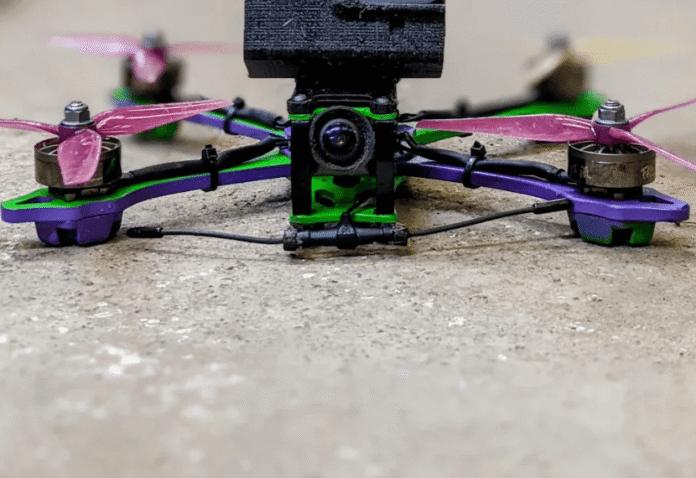

When building an FPV drone, most pilots naturally focus on motors, propellers, batteries, and flight controllers. The electronic speed controller, or ESC, often receives less attention. Yet the ESC is one of the most important components in the propulsion system because it controls the power delivered to the motors.
Choosing the wrong ESC can lead to overheating, voltage-related failures, poor motor performance, or even damage to other electronics. Choosing the right one, on the other hand, creates a reliable foundation for the entire power system.
The key is to select an drone ESC based on the complete drone rather than looking at the advertised amp rating alone.
What Does an ESC Do?
An electronic speed controller converts commands from the flight controller into electrical signals that control the motors.
In a typical FPV quadcopter, there are four motors and four ESC channels. The ESC rapidly switches electrical current through the motor windings, allowing the brushless motors to accelerate, slow down, and change speed as the flight controller requests.
This happens continuously during flight.
When the pilot moves the throttle or control sticks, the flight controller calculates how much power each motor needs. The ESC then adjusts motor speed accordingly.
Because this process happens thousands of times during a flight, the ESC needs to respond quickly and reliably while handling significant electrical loads.
4-in-1 ESC vs. Individual ESCs
FPV drones can use either individual ESCs or a 4-in-1 ESC.
A 4-in-1 ESC combines four motor controllers onto a single circuit board. This design is extremely common on modern FPV quads because it simplifies wiring and installation.
A typical stack may consist of:
Flight Controller → 4-in-1 ESC → Four Motors
Individual ESCs, sometimes called single ESCs, place one controller on each motor arm. This approach can make sense for certain specialized builds, but it usually requires more wiring and installation space.
For most modern 5-inch FPV builds, a 4-in-1 ESC provides a convenient balance of performance, size, and installation simplicity.
Check the Battery Voltage First
Battery voltage is one of the first specifications you should check when selecting an ESC.
FPV batteries commonly come in configurations such as 4S and 6S. A 6S battery has a higher nominal voltage than a 4S pack and therefore requires an ESC capable of handling the corresponding voltage.
The ESC must also tolerate the battery’s maximum fully charged voltage, not just its nominal rating.
For this reason, never assume that an ESC designed for a 4S setup will automatically be appropriate for 6S.
Always check the manufacturer’s voltage specifications before connecting a battery.
How Much Current Does Your Drone Need?
The amp rating is one of the most important ESC specifications.
During flight, the motors draw current from the ESC. Aggressive throttle use, high-pitch propellers, heavy drones, and powerful motors can all increase current demand.
An ESC rated at 60A, for example, is designed to handle more current than a 30A model under the manufacturer’s specified conditions.
However, selecting an ESC should not simply be a matter of choosing the highest number available.
Instead, estimate the maximum current your motor and propeller combination is likely to draw and choose an ESC with a sensible safety margin.
If a motor can draw significant current at full throttle, the ESC should be capable of handling that load without operating continuously at its limit.
Why an ESC Safety Margin Matters
An ESC may survive occasional peaks near its rated limit, but consistently operating at the maximum rating can increase heat and reduce reliability.
A safety margin provides additional protection against real-world conditions.
For example, a drone may experience higher loads than expected because of a heavier battery, a different propeller, aggressive maneuvers, or restricted airflow.
Temperature also matters. An ESC operating in a hot environment may have less thermal headroom than the same ESC operating in cooler conditions.
For performance builds, selecting an ESC with some additional current capacity can therefore be a sensible approach.
Match the ESC to the Motors
The ESC and motor should always be considered as a pair.
Motor KV, stator size, propeller size, propeller pitch, battery voltage, and drone weight all affect current demand.
A high-performance motor paired with an aggressive propeller can place considerably more stress on the ESC than a smaller motor using a lightweight, low-pitch propeller.
This means that an ESC cannot be selected based on motor size alone.
Before buying, look for the motor manufacturer’s recommended voltage and propeller combinations. If thrust or current test data is available, use it to estimate the maximum current requirements of the complete power system.
Consider the Propeller
The propeller is often overlooked when selecting an ESC, but it can have a major effect on motor current.
A larger or higher-pitch propeller generally creates a greater load on the motor. The motor then needs to draw more current to maintain the required RPM.
Changing from one propeller to another can therefore significantly alter the electrical demands of an otherwise identical setup.
For this reason, it is not enough to say that a particular motor requires a certain ESC. The motor-propeller-battery combination should be evaluated together.
This is especially important for freestyle and racing drones, where pilots may experiment with different propellers to change throttle response and handling.
Check ESC Protocol Compatibility
The ESC also needs to communicate correctly with the flight controller.
Modern FPV systems use digital communication protocols between the flight controller and ESC. The exact protocol and supported features can vary between hardware and firmware.
A compatible setup allows the flight controller to control motor speed accurately and may also provide additional information such as ESC telemetry.
When purchasing an ESC and flight controller separately, check the manufacturer’s wiring diagram and specifications.
A compatible stack can simplify installation because the boards are designed around the same mounting pattern and electrical connections.
ESC Telemetry Can Be Useful
ESC telemetry allows information from the ESC to be sent back to the flight controller.
Depending on the hardware, this can include information related to motor RPM, temperature, current, voltage, or other operating conditions.
This data can be useful when troubleshooting a drone.
For example, if one motor is consistently running hotter than the others, telemetry or blackbox data may help identify an underlying problem.
Not every pilot needs advanced telemetry features, but they can be valuable for experienced builders who want greater insight into the performance of their power system.
Pay Attention to Cooling
ESCs generate heat during operation.
High current loads, aggressive flying, warm ambient temperatures, and restricted airflow can all increase ESC temperature.
A good frame layout can help provide airflow around the electronics. The ESC should also be installed in a way that does not trap excessive heat between tightly packed components.
This is another reason not to operate an ESC continuously at its maximum rated current.
A larger current rating can provide additional thermal headroom, although physical design and cooling remain important.
What Is BLHeli and Why Does It Matter?
Many FPV ESCs use firmware designed for brushless motor control. The firmware determines how the ESC operates and which configuration features are available.
Depending on the ESC generation and hardware, pilots may encounter different firmware ecosystems and protocols.
When selecting an ESC, check whether it is supported by the configuration tools and firmware you intend to use.
For beginners, a widely supported ESC can make configuration and troubleshooting easier. For experienced pilots, advanced settings and telemetry capabilities may be more important.
The specific firmware is less important than ensuring that the ESC is properly supported by your flight-control setup.
Choosing an ESC for Different FPV Drones
Different drone types require different ESC characteristics.
5-Inch Freestyle
A 5-inch freestyle drone generally needs an ESC capable of handling powerful motors and frequent throttle changes. A 4-in-1 ESC with sufficient current capacity is a common solution.
Racing Drones
Racing drones prioritize low weight and rapid motor response. The ESC should provide enough current capacity without adding unnecessary weight.
Long-Range Drones
Long-range drones may emphasize efficiency and reliability. Their ESC should match the larger motors and propellers commonly used on these aircraft while providing sufficient voltage headroom.
Cinewhoops
Cinewhoops may carry additional camera equipment, increasing the total aircraft weight. The ESC therefore needs to support the motor-propeller combination under the increased load.
A Practical ESC Selection Checklist
Before purchasing an ESC, check the following:
Battery voltage: Is it rated for your 4S, 6S, or other battery configuration?
Current rating: Can it handle the expected motor current with a reasonable safety margin?
Motor compatibility: Does it work with your motor and propeller combination?
Mounting pattern: Will it physically fit your frame or stack?
Flight controller compatibility: Are the connector and pinout compatible?
Firmware: Is the ESC supported by the software ecosystem you plan to use?
Telemetry: Do you need current, temperature, RPM, or other telemetry information?
Cooling: Does your frame provide sufficient airflow around the ESC?
Considering all of these factors is much more reliable than selecting an ESC based only on price or amp rating.
Finding the Right Drone ESC
When comparing a drone ESC, it is useful to evaluate it alongside the motors, battery, propellers, and flight controller that will be used in the same build.
MEPSKING is one example of an FPV-focused retailer where pilots can compare ESCs with other drone components. Looking at the complete power system can help ensure that the selected ESC is not only powerful enough but also physically and electrically compatible with the rest of the build.
For beginners, a proven 4-in-1 ESC and flight controller stack can often be the simplest starting point. More experienced pilots may prefer to select individual components based on their exact requirements.
Final Thoughts
The ESC may not be the most visible component on an FPV drone, but it plays a critical role in converting battery power into controlled motor performance.
The right ESC should match the battery voltage, motor characteristics, propeller load, and expected current demand. It should also provide appropriate communication, mounting compatibility, firmware support, and thermal capacity.
Instead of asking, “What is the highest-rated ESC I can buy?”, ask a better question: “What ESC is appropriate for my complete power system?”
Once you approach ESC selection this way, it becomes much easier to build an FPV drone that is reliable, efficient, and capable of delivering the performance you expect.

