
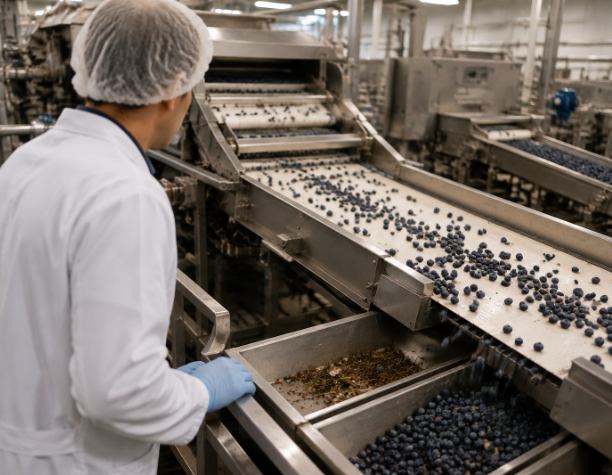

The obvious measure of a food processing line is speed: how much product it moves through in an hour. The number that decides profitability is less visible: yield, the share of incoming raw product that leaves the line as sellable output. A line can run fast and still lose money if too much good product ends up in the waste stream.
Yield Is Where the Margin Lives
Raw ingredients are the highest cost in most food operations, so what happens to them during processing matters enormously. A plant that turns 92 percent of its incoming product into sellable goods and one that turns 88 percent look identical on a tour, but that four-point gap is pure margin, repeated across every ton that runs. In a business measured in fractions of a cent per unit, yield is often the line between a profitable operation and a struggling one, and the equipment doing the processing draws that line.
Where Good Product Becomes Waste
Processing steps physically handle and transform product, and each handoff is a chance to lose some. The losses are rarely dramatic. They accumulate:
- Bruising and breakage from rough handling or hard transfers
- Over-trimming that discards good product along with the bad
- Imprecise cutting or sizing that creates off-spec, unsellable pieces
- Good product misdirected into the waste stream by an inaccurate sort
None of these looks like much on a single piece. Multiplied across millions of units a shift, they are the difference between the two yield numbers above. Well-built Food Processing Equipment is judged less by how fast it runs than by how little sellable product it turns into waste at that speed.
Precision Protects What Speed Cannot
This is where the equipment’s design earns its cost. Gentle handling keeps delicate products intact instead of bruised. Precise cutting and sizing keep more of each piece on-spec and sellable. Accurate separation sends only true defects to waste and keeps the good product moving forward. A machine that runs quickly but loses a point of yield is often a worse buy than a slightly slower one that protects the product, because yield is the number that stays on an operation’s books month after month.
The Line Wins or Loses Together
Yield is not set by any single machine but by the whole line, since product passes through several steps and each transfer is another chance for loss. Equipment designed to work together, with clean handoffs between processing, conveying, and sorting, protects the product across the entire path rather than at one point. Manufacturers that build these systems as an integrated line tend to treat yield as a property of the whole line, since a gentle process step feeding into a rough transfer simply returns the yield. Protecting product at one station counts for little if the next one bruises it.
Throughput is easy to see and easy to sell. The harder, more valuable number is how much of what goes in comes out as product, and that depends less on how fast a line runs than on how carefully it treats what it runs.

