
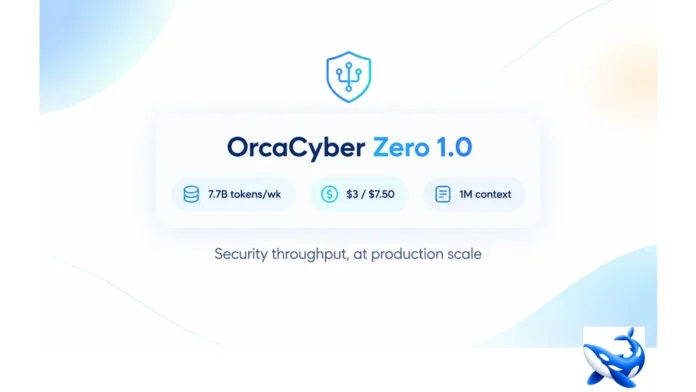

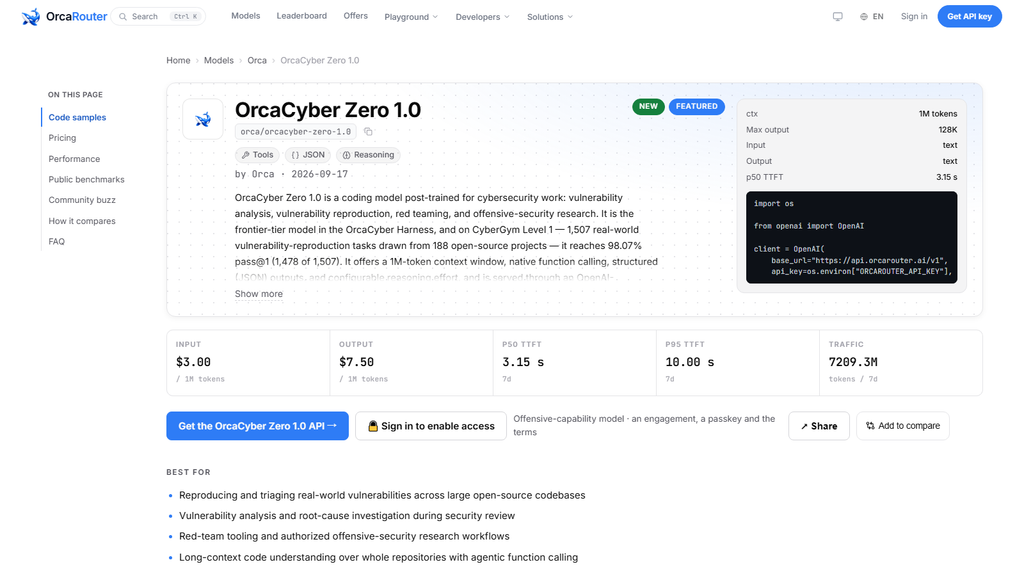
On OrcaRouter we host the OrcaCyber Zero 1.0 model — our security-specialized model, shipped on September 17, 2026, priced at $3 per million input tokens and $7.50 per million output, with a 1M-token context window and a 128K maximum output. In production its p50 time-to-first-token is 2.93 seconds and its seven-day token volume is 7,676.6 million — the largest seven-day figure on this board, an order of magnitude above any other card in this cluster. It is our own product, so no independent third-party score exists to cite; the production record above is the evidence, with the live telemetry on the linked page.
The largest traffic figure in this whole cluster belongs to a security model — that is the number this article starts from, and it is worth understanding before any of the specs.
The traffic that outruns the fleet
The production record is the headline, and the number is not small: 7,676.6 million tokens in seven days, against a cluster where the next-largest figure is measured in hundreds of millions. A security-specialized model is not the intuitive candidate for the board’s biggest traffic, and the reading says something specific about what that traffic is: security workloads run continuously, at scale, and they spend their tokens on exactly the kind of repeated, trusted, non-interactive passes that accumulate volume. This is not a spike and not a sample — it is a week of real production traffic on our own endpoint.
The honest framing is that this is our own telemetry, and the article will not pretend otherwise. Because OrcaCyber Zero 1.0 is our product, there is no independent third-party benchmark to cite, and the production record is the evidence. The traffic is the strongest number on the card, and it is the one this article leads with because it is the one a buyer cannot see anywhere else.
Our security model on our board
| card | kind | input / output | context | p50 TTFT | 7-day tokens |
| OrcaCyber Zero 1.0 | security | $3 / $7.50 | 1M | 2.93 s | 7676.6M |
| OrcaVerify Text 1.0 | verification | $2 (input) | not listed | 0.115 s | 82.5K |
| OrcaDub 1.0 | audio | $0.60 / minute | not applicable | — | — |
Rate cards, context windows and the p50 and token figures are from the linked pages on the platform; all three cards are our own products, so no independent scores apply to any row. The table is the security and tooling row of our own lineup: the security model carrying the board’s largest traffic at a $3 / $7.50 rate, the verification card answering in 115 milliseconds at an input-only price, and the audio card billed by the minute. The column worth a long look is the last one — the 7,676.6 million tokens dwarf the verification card’s 82.5K by five orders of magnitude, which is the whole story of where security-model volume actually lives.
What security-scale tokens look like in production
The 2.93-second p50 first token is the figure that makes the volume legible. A security model that answers in under three seconds at this scale is doing the kind of work that fills a 7,676.6-million-token week: scanning, classifying, and checking in continuous passes where each request is short, each context is drawn from the 1M window, and the aggregate is enormous. The latency matters precisely because the workload is volume-shaped — a slow first token would have throttled this traffic before it ever reached this scale.
The 1M context window is the other half of the same design. Security analysis leans on full-corpus context — a whole codebase, a full log suite, a complete event stream read at once — and the 1M window is what makes the passes single-request instead of chunked. The $3 / $7.50 rate is the premium a security workload pays for that shape, and the traffic column says the market has accepted the price.
One more figure from the card explains how the volume stays this high without the first token getting in the way: the 128K maximum output. Security passes are short-output work — a verdict, a classification, a flagged diff — and a ceiling that high means the model never truncates the tail of a long report, so the same request does not have to be run twice. Short inputs, deep context drawn from the 1M window, and an output ceiling that absorbs the whole answer: that combination is what a continuous 7,676.6-million-token week is built from, and it is why the $3 / $7.50 rate is not the obstacle it would be for a generation-heavy workload. The verification card beside it answers in 115 milliseconds but moves a rounding error of the tokens, because that workload is request-shaped, not volume-shaped; the security card’s 2.93-second p50 is slower on paper and far busier in practice, which is the honest difference between a low-latency niche and a production mainstay.
Reading our own record without overstating it
The discipline for an article about our own product is to say what the record does and does not prove. The production record proves that OrcaCyber Zero 1.0 runs security-scale workloads reliably and fast enough to accumulate 7,676.6 million tokens in a week — that is our own telemetry, measured on our own endpoint, and it is the strongest evidence this article can offer. What the record does not do is compare the model against an independent third-party benchmark, because none exists to cite, and this article will not invent one.
The honest conclusion is a measured one: a security-specialized model with the largest traffic on the board, a 2.93-second first token, and a 1M window, priced at $3 / $7.50 and proven at volume on our own platform. The traffic is the evidence, the caveat is that it is our evidence, and the buyer’s choice is whether the production record on the linked page is what they need. For a security team, the answer this article gives is that the record is exactly what a production decision should be built on.
The takeaway
OrcaCyber Zero 1.0 is our security-specialized model: $3 / $7.50, a 1M context window and a 128K maximum output, a p50 first token of 2.93 seconds, and a seven-day token volume of 7,676.6 million — the largest figure on this board. It is our own product, so no independent score exists to cite, and the production record is the evidence. That record says a security card can run at fleet-leading volume when the latency and the context window fit the workload, and this article reports it in measured terms. If your security work runs at scale, the card is live — with the telemetry on the linked page.
Sourcing note: OrcaCyber Zero 1.0 is our own product, hosted on our own platform, so all figures — the $3 / $7.50 rate card, the 1M context window, the 128K maximum output, the p50 time-to-first-token and the seven-day token volume — are OrcaRouter production data from the linked model page as of 2026-10-08. No independent third-party benchmark exists for this card, and none is implied. All checked 2026-10-08.