
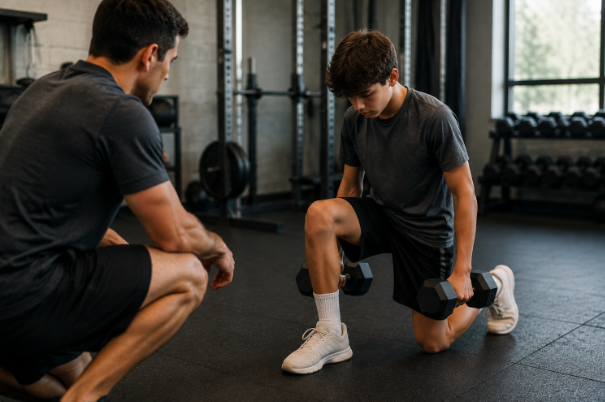

A lot of youth sports training treats young athletes as smaller versions of adults, or pushes them to specialize and grind as early as possible. Good coaches, and a fair amount of research, point the other way: toward building a broad, durable athlete over years rather than squeezing results out of a single year.
A Growing Body Is Not a Finished One
Children and teenagers are still developing. Bones, tendons, and the coordination that ties movement together are all maturing, which means a young body does not respond to training the way an adult’s does. Loading a teenager like a grown lifter, or repeating one sport’s exact motion the whole year round, is a reliable way to invite overuse injuries, the sore elbows, stress fractures, and aching knees that show up when a still-growing joint does the same thing too many times. Training that respects where a young body actually is tends to keep athletes healthy enough to keep playing. Health, at that age, is the foundation everything else is built on.
A Broad Base Beats an Early Specialty
There is steady pressure to pick one sport young and pour everything into it, but the pattern rarely pays off the way parents hope. General athleticism built first, running, jumping, changing direction, basic strength, and a range of movements, tends to produce a better athlete later than early, narrow specialization does. Early specialization is also linked to higher rates of injury and burnout without a lasting competitive edge. This is where a Personal Trainer in Los Alamitos, CA can matter for a young athlete: building the wide foundation that a single team practice usually does not, before the body is asked to specialize.
The Point Is the Next Decade, Not This Year
Good youth training is measured over years, not by one set of results. A young athlete developed patiently, with movement skills, appropriate strength, and steady progression, arrives at the ages that matter more capable and less broken down than one who peaked early and paid for it. A few priorities tend to guide that longer view:
- Movement quality before heavy load or high volume
- Variety instead of the same motion repeated all year
- Progression matched to growth, not to a competition schedule
The athlete who is still healthy and improving later usually beats the one who burned bright and faded.
Competence Is the Lasting Result
The most valuable thing a young athlete gains from real coaching is not a trophy; it is understanding how to train. A kid who learns good form, sensible progression, and how their own body responds carries those habits into adult fitness long after the youth sport ends. Coaches who take this view tend to treat development as the goal rather than a short-term win. Every young athlete grows at their own pace, so guidance works best when it meets the individual rather than a template.
A young athlete is not a small adult, and training one like an adult trades a long, healthy athletic life for a quick result. Built patiently, the same young athlete tends to go further, and to still be enjoying the sport at the age when it finally counts, rather than nursing an injury from doing too much too soon.

