
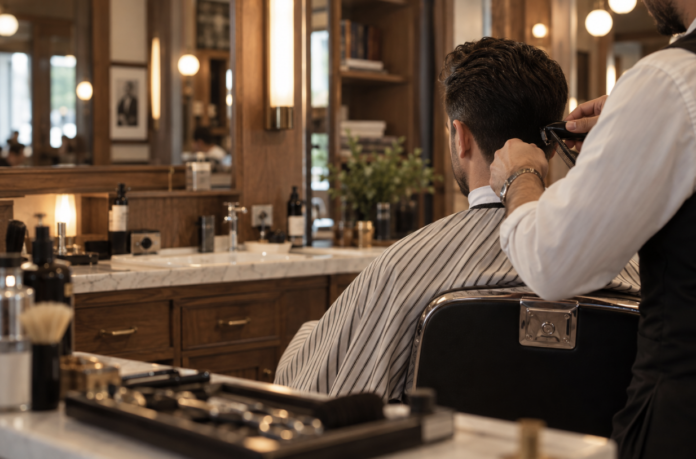

Men who have found their barber tend to stop looking entirely. They book the same chair every few weeks, often with the same person, and will drive past three closer shops to get there. That loyalty is worth examining, because the things that produce it are rarely the things shops advertise.
Consistency Between Visits
The first test is whether the cut holds. A haircut that looks sharp at the chair and shapeless by the following weekend has not done its job, and regulars notice this faster than anything else.
Barbers who keep clients cut for the week ahead rather than the moment. That means accounting for how fast the hair grows, which direction it sits, and what it will do once the styling product is washed out. The result is a man who stops thinking about his hair between appointments, which is most of what he was paying for.
A Read on the Head in Front of Them
Skill shows in the first thirty seconds. An experienced barber looks at the shape of a head, the hairline, the cowlicks, and the way the previous cut has grown out before touching anything.
Questions matter too. A barber who asks what did not work last time learns more in one exchange than a stylist following a photograph. Regulars also expect their history to be remembered. Clients comparing a Barbershop in Southlake, TX often settle on whichever barber recalls the last cut without being prompted and adjusts it without being asked twice.
The Room Around the Chair
A barber works inside a space, and the space affects whether an appointment feels like an errand or a break in the day.
What regulars tend to value:
- Volume low enough that talking does not require effort
- One record or one film rather than competing noise
- Pricing set for a barbershop and not borrowed from a salon
- Extras included rather than itemized, such as a hot towel or a shoulder massage at the end
None of that is costly to provide. It mostly comes down to deciding what the room is meant to feel like.
The Conversation Is Optional
Good barbers read the client as well as the hair. Some men arrive wanting to talk about sports, work, or whatever is in the news. Others want twenty minutes without saying much at all.
A barber who follows the client’s lead rather than filling silence out of habit tends to keep both types. Regulars describe this as being treated like a person rather than an appointment slot, and it is one of the more common reasons a man stays with the same chair for years.
The same instinct shows up in how a shop handles fathers and sons. Booking two chairs together, or taking time with a nervous five year old on a first haircut, earns a second generation of business from one small accommodation. That kind of loyalty is not bought through marketing. It is earned one appointment at a time, by a barber who treats each cut as something worth doing properly.

