
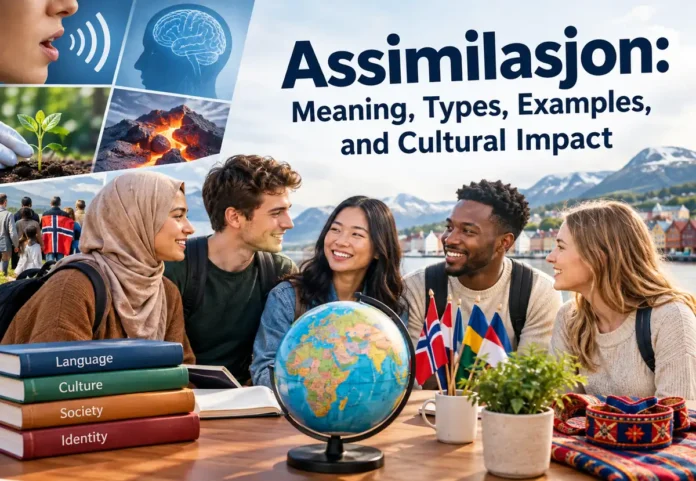

Assimilasjon is the Norwegian word for assimilation, meaning a process in which a person, group, sound, idea, or substance becomes more similar to or incorporated into something else. In everyday discussion, it most often refers to cultural assimilation, especially when people adopt the language, customs, values, or social habits of a larger or dominant society. The term also has technical meanings in linguistics, psychology, biology, and geology. The correct meaning depends on the subject being discussed and the surrounding context.
What Does Assimilasjon Mean?
At its broadest level, assimilasjon describes change through becoming more alike or becoming part of an existing system. In cultural studies, it can describe immigrants or minority groups adopting features of the wider society around them. In linguistics, it refers to one sound becoming more like another nearby sound. In science and psychology, the same basic idea of incorporation appears in different forms.
The cultural meaning is the one readers most often meet in discussions of immigration, identity, education, language, and national history. Assimilation can happen gradually through normal social contact, or it can result from pressure imposed by institutions or governments. That distinction matters because voluntary adaptation and forced cultural change have very different consequences.
How Cultural Assimilasjon Happens
Cultural assimilasjon usually develops through repeated contact with the majority culture. School, work, friendships, neighborhoods, media, marriage, and public institutions can influence the language people use and the habits they adopt. Children of immigrants may experience these influences strongly through schools and peer groups. This can make assimilation more visible across generations.
Language often changes first because it affects education, employment, healthcare, and everyday communication. A family may use the majority language outside the home while continuing to use a heritage language with relatives. Food, clothing, celebrations, music, and religious practices may change at different speeds. Assimilation is therefore better understood as a spectrum than an all-or-nothing process.
Voluntary and Forced Assimilasjon
Voluntary assimilation happens when people choose to adopt parts of another culture for social, practical, or personal reasons. Someone may learn a national language, follow workplace customs, or join local traditions while still maintaining family practices and a connection to their heritage. This can support participation without complete cultural loss. Choice remains the central feature.
Forced assimilation occurs when authorities or powerful institutions pressure a minority group to abandon its language, beliefs, customs, or identity. Schools, laws, land rules, religious institutions, or unequal access to public life can all be used to encourage conformity. The effects may include language decline, broken cultural transmission, mistrust, and long-term harm across generations. This makes forced assimilation fundamentally different from ordinary cultural exchange.
Assimilasjon in Norwegian History
The Norwegian context gives the word particular historical weight because of the policy known as fornorsking, or Norwegianization. Norwegian authorities used assimilation policies toward Sámi and Kven or Norwegian Finnish communities, while schools and other institutions promoted Norwegian language and culture. Norway’s Truth and Reconciliation Commission investigated these policies and their continuing consequences. It delivered its report to the Storting on June 1, 2023.
Official Norwegian sources describe lasting effects on minority languages and cultural continuity. In November 2024, the Storting apologized for abuses connected with Norwegianization policies affecting Sámi, Kven or Norwegian Finn, and Forest Finn communities. Modern policy now includes measures intended to protect and strengthen minority languages such as Sámi and Kven. This history explains why assimilasjon can carry political and emotional weight in Norway.
Assimilasjon vs Integration, Multiculturalism, and Acculturation
Assimilation and integration both describe adaptation, but they place different expectations on cultural identity. Assimilation usually implies becoming more similar to the majority culture, while integration allows participation without giving up important parts of one’s original identity. A person can work, study, speak the national language, and join community life while still maintaining family traditions. That pattern fits integration more closely than complete assimilation.
Multiculturalism describes a society in which different cultural groups can remain visible while sharing the same political and social space. Acculturation is a broader term for cultural change that happens when groups remain in sustained contact, and it does not require one group to become like another. These concepts overlap, but they describe different processes and outcomes.
Identity, Language Loss, and Generational Change
Assimilation can affect identity without completely replacing it. First-generation immigrants may retain strong ties to the language and customs of the place where they grew up, while their children may move between family culture and majority culture. Later generations may speak the heritage language less often but still identify with their ancestry. Bicultural and mixed identities are therefore common outcomes of long-term cultural contact.
Language loss matters because language carries family stories, humor, place names, oral traditions, and cultural knowledge. When a majority language dominates education, work, government, and media, parents may gradually stop passing a minority language to children. Once intergenerational transmission weakens, fluency can decline rapidly. Bilingual education, community teaching, media, and language revival programs can help preserve or rebuild transmission.
Assimilasjon in Linguistics
In linguistics, assimilasjon has a precise meaning unrelated to cultural identity. One speech sound becomes more similar to a nearby sound because the mouth is preparing for what comes before or after it. This often makes connected speech faster and easier to produce. The change may affect place of articulation, voicing, or another sound feature.
Regressive assimilation happens when a later sound influences an earlier one, while progressive assimilation works in the opposite direction. For example, an “n” sound can move toward an “m” sound before consonants such as “p” or “b.” Similar patterns appear in Norwegian and English and often occur naturally in fast speech. They are normal phonetic processes rather than automatic pronunciation errors.
Assimilasjon in Psychology
In psychology, assimilasjon is closely associated with Jean Piaget’s theory of cognitive development. Assimilation happens when a person understands new information by fitting it into an existing mental schema. A child who already understands the category “dog” may recognize an unfamiliar breed as another dog without changing the category. Existing knowledge is used to interpret the new experience.
Accommodation occurs when existing knowledge must change because new information does not fit. A child who first calls every furry four-legged animal a dog may need a new category after learning what a cat is. Assimilation uses an existing schema, while accommodation modifies or creates one.
Assimilasjon in Biology and Geology
In biology, assimilation refers to the incorporation and use of substances by living organisms. Digestion breaks food down, absorption moves nutrients into the body, and assimilation describes how cells and tissues use those nutrients. Plants also assimilate carbon and nitrogen as they build organic compounds needed for growth. The term therefore refers to biological use, not simply to taking a substance in.
Geology uses assimilation in another technical sense. Magma can interact with surrounding rock, and some of that material may melt or become incorporated into the magma. The geological process has nothing to do with culture or language. It simply keeps the broader idea of one material becoming part of another system.
Assimilasjon in Modern Life
Modern assimilation is often less one-directional than older models suggest. Migration, education, travel, and social media allow cultural influence to move between majority and minority communities. People may adopt global music, fashion, slang, or work habits while maintaining local family traditions. Hybrid identities can develop without complete cultural replacement.
How to Identify the Meaning of Assimilasjon
The easiest way to understand assimilasjon is to look at the words around it. References to immigration, identity, minority groups, language rights, or integration usually point to the cultural meaning, while pronunciation and sound change point to linguistics. Schemas and learning point to psychology, nutrients and cells point to biology, and magma or surrounding rock point to geology. Context normally removes the ambiguity quickly.
The shared idea across all meanings is incorporation or increasing similarity, but the mechanism changes by field. Cultural assimilation concerns social identity, linguistic assimilation concerns speech sounds, psychological assimilation concerns knowledge, and biological or geological assimilation concerns material incorporation. Keeping these categories separate makes the term easier to understand.
Frequently Asked Questions
What does Assimilasjon mean in English?
Assimilasjon generally means “assimilation” in English. It describes becoming more similar to or incorporated into something else. The exact meaning depends on the field.
Is Assimilasjon mainly a cultural term?
Yes, it is commonly used for cultural assimilation, especially in discussions of immigration and identity. Other fields also use it. Linguistics, psychology, biology, and geology give the term technical meanings.
Is assimilation the same as integration?
No, the concepts differ. Assimilation usually involves becoming more similar to the majority culture. Integration allows participation in society while preserving important parts of one’s original culture.
Can assimilation happen without losing cultural identity?
Yes, people can adopt a new language or social habits while keeping family traditions and heritage. Cultural change can be selective. Assimilation often occurs in degrees rather than replacing identity completely.
What is forced assimilation?
Forced assimilation happens when powerful institutions pressure a group to abandon its language, beliefs, or customs. Choice becomes limited. It differs from voluntary adaptation because conformity is imposed rather than freely chosen.
What does Assimilasjon mean in linguistics?
In linguistics, assimilasjon occurs when one speech sound becomes more like a nearby sound. This often happens naturally. The change can make connected speech easier and more efficient to pronounce.
What is Assimilasjon in psychology?
In Piagetian psychology, assimilation means fitting new information into an existing mental schema. The schema stays largely unchanged. Accommodation differs because the person changes the schema when new information no longer fits.