
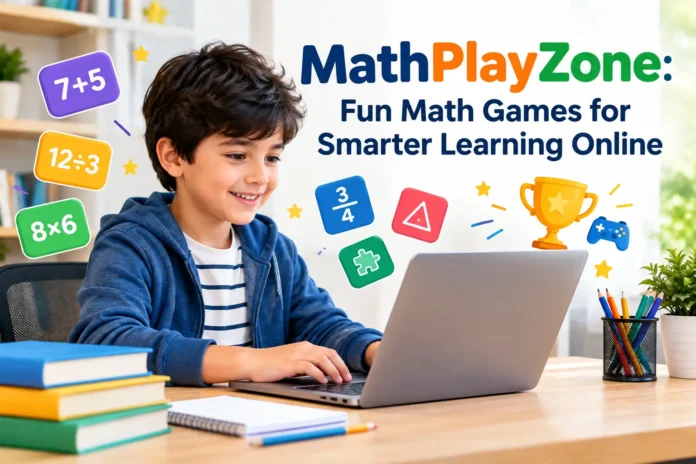

MathPlayZone refers to an online approach to math practice that combines mathematical problems with interactive games, puzzles, and learning challenges. Instead of depending entirely on worksheets, learners can practice skills while making decisions, solving problems, and receiving immediate responses during an activity.
The format is especially relevant to school-age learners who need additional practice but lose interest when exercises become repetitive. MathPlayZone therefore focuses on making regular mathematical practice more approachable without replacing structured teaching.
What Is MathPlayZone?
MathPlayZone is generally described as a browser-based educational resource centered on interactive mathematics practice. Competitor coverage associates it with areas such as addition, subtraction, multiplication, division, fractions, geometry, and logical reasoning. Rather than presenting every question as a conventional exercise, the game-based format places mathematical decisions inside activities that give learners a reason to continue practicing.
This approach changes how a child experiences repetition, which remains necessary for developing many basic math skills. Solving twenty similar questions on paper can feel monotonous, while solving comparable calculations as part of a challenge can create a clearer short-term goal. The mathematical work still matters, but the activity surrounding it can make repeated practice easier to tolerate. That distinction explains much of the interest in educational math gaming.
How MathPlayZone Makes Math More Interactive
Interactive math activities require learners to respond rather than simply read an explanation. A child may calculate an answer, recognize a number pattern, compare quantities, identify a shape, or decide which strategy solves a puzzle. The activity then reacts to that choice, allowing the learner to continue, retry, or approach the problem differently. This feedback cycle can make practice feel more active than completing a static page of questions.
Games can also provide meaningful reasons to use mathematical knowledge. Multiplication may help a player complete a stage, while spatial reasoning may become part of navigating a puzzle or arranging shapes. Logic activities can require learners to identify patterns and eliminate incorrect possibilities before acting. These situations encourage students to use mathematical thinking rather than viewing every skill as an isolated calculation.
Math Skills Students Can Practice
Basic arithmetic forms an important part of online math practice. Addition and subtraction activities can strengthen number recognition, mental calculation, and understanding of relationships between quantities. Multiplication and division practice can help learners become more comfortable with number facts that appear repeatedly in later mathematics. Stronger fluency in these areas can also reduce the effort required when students begin working with more complex problems.
Fractions, decimals, percentages, and geometry introduce learners to mathematical ideas beyond whole-number calculations. Fraction activities can demonstrate parts of a whole visually, while geometry challenges can involve shapes, angles, measurement, and spatial relationships. Logic and strategy puzzles add another dimension because the correct solution may depend on planning rather than calculation speed. Competitor coverage consistently identifies arithmetic, fractions, geometry, and reasoning among the main MathPlayZone learning areas.
Educational Benefits of MathPlayZone
One practical advantage of game-based math practice is the opportunity for repeated participation. Students rarely master a skill after seeing it once, so useful practice requires them to encounter related problems multiple times. A game can provide that repetition while changing the immediate challenge, objective, or situation. This can make continued practice feel less repetitive even when the underlying mathematical skill remains the same.
Interactive practice may also create a lower-pressure environment for making mistakes. When students can retry a challenge, an incorrect answer becomes information they can use on another attempt rather than simply a mark on a worksheet. This process can encourage experimentation with different strategies when activities are designed around problem-solving. However, improvement still depends on whether the learner understands the mathematics behind successful answers rather than merely memorizing game actions.
Building Problem-Solving and Logical Thinking
Mathematics involves much more than performing calculations quickly. Learners also need to recognize patterns, select relevant information, plan steps, test ideas, and decide whether an answer makes sense. Logic games can provide practice with several of these processes without presenting them as formal equations. A puzzle may require the learner to think ahead before choosing an action, making reasoning part of the gameplay itself.
These skills become particularly useful when students encounter unfamiliar mathematical questions. Memorized procedures work well when a problem looks familiar, but reasoning becomes more important when its structure changes. Interactive challenges can encourage learners to pause, analyze available information, and adjust unsuccessful approaches. That makes logic-based activities a useful complement to arithmetic fluency practice.
MathPlayZone for Different Learning Levels
A useful math activity should match what a learner currently understands while still providing a manageable challenge. Younger students generally benefit from number recognition, counting, simple addition, subtraction, shapes, and early pattern activities. Learners with stronger foundations can move toward multiplication, division, fractions, decimals, percentages, geometry, and multi-step reasoning. Competitors commonly position MathPlayZone-style content toward elementary learners, although descriptions of the exact supported age range vary.
Difficulty matters because an activity that is too easy provides little meaningful practice, while one that is far beyond the learner’s current ability can create frustration. Parents and teachers should therefore select games according to the mathematical skill being studied rather than choosing only by appearance or entertainment value. A student struggling with multiplication facts gains more from targeted multiplication practice than repeatedly playing an unrelated logic game. Matching activities to learning needs turns gaming time into purposeful practice.
How Parents Can Use MathPlayZone at Home
Parents can make online math practice more effective by connecting it with what the child is learning at school. If the current classroom topic is fractions, for example, choosing fraction activities creates another opportunity to work with the same concept in a different format. Short, consistent sessions can also be easier to maintain than occasional long practice periods. The goal should be regular engagement with appropriate mathematics rather than simply accumulating screen time.
Parents should occasionally ask children to explain how they reached an answer. A correct explanation shows more understanding than repeatedly reaching the right result through guessing or memorizing a game pattern. Asking questions such as why a strategy worked or how another solution could be found can reveal whether the learner understands the underlying concept. This simple conversation helps connect digital gameplay with mathematical reasoning.
How Teachers Can Use MathPlayZone
Teachers can use interactive math activities as a supplement to direct instruction rather than treating them as a complete curriculum. Games can work as lesson warm-ups, review activities, independent practice, learning-station tasks, or additional exercises for students who finish other work early. Several competitor guides specifically present MathPlayZone as a classroom supplement for reinforcing concepts and encouraging active participation. Used selectively, the format can provide variety without changing the learning objective.
The activity should still connect to a specific instructional purpose. Teachers can choose a game that reinforces the day’s concept and follow it with a short discussion, written problem, or explanation task. This combination makes it easier to see whether students can transfer what they practiced into conventional mathematical work. Entertainment then supports instruction instead of becoming the purpose of the lesson.
Getting Better Results From MathPlayZone
Students should begin with a clear practice goal instead of moving randomly between games. One session might focus on multiplication accuracy, while another could concentrate on fractions or logical reasoning. Staying with one skill long enough to recognize improvement provides more educational value than constantly switching activities. Learners can increase the difficulty once they solve problems accurately and can explain the method they used.
Digital practice should also remain part of a broader learning routine. Written calculations develop the ability to organize mathematical work, while verbal explanations help students communicate reasoning and identify misunderstandings. Classroom teaching, practical examples, reading, and hands-on activities provide forms of learning that games cannot fully reproduce. MathPlayZone works best when interactive practice reinforces these other experiences rather than replacing them.
How to Tell Whether Math Practice Is Working
Enjoyment alone does not prove that a student has learned a mathematical skill. Parents and teachers can look for practical changes such as greater accuracy, fewer repeated mistakes, improved confidence with familiar questions, and an ability to solve similar problems outside the game. A learner who succeeds only inside one activity may have learned its mechanics rather than the mathematical concept. Transfer to a different type of question provides stronger evidence of understanding.
A simple check can take place after a practice session. Give the learner two or three related problems without the game and ask for an explanation of each solution. If the student can solve them independently and describe the reasoning, the digital activity is likely reinforcing useful knowledge. If not, the learner may need clearer instruction before additional game practice.
Conclusion
MathPlayZone offers a practical way for students to strengthen math skills through interactive games, puzzles, and problem-solving activities. It can make repeated practice more engaging while supporting arithmetic, fractions, geometry, logical thinking, and other essential skills.
Parents and teachers can get better results by choosing activities that match the learner’s current level and connecting digital practice with classroom lessons. Used alongside written work and structured instruction, MathPlayZone can become a useful part of a balanced math-learning routine.
FAQs About MathPlayZone
What is MathPlayZone?
MathPlayZone refers to an online math-learning resource built around interactive games, puzzles, and challenges. It helps learners practice mathematical skills in a more engaging format. It can supplement regular instruction.
What math topics can students practice?
Commonly discussed topics include addition, subtraction, multiplication, division, fractions, decimals, percentages, geometry, logic, and problem-solving. Available activities can differ by level. Learners should choose topics matching current needs.
Is MathPlayZone suitable for young children?
MathPlayZone-style activities are primarily associated with school-age learners, especially elementary-level mathematics. Younger children should begin with simple number and shape activities. Adult guidance can help select suitable difficulty.
Can MathPlayZone replace regular math lessons?
No, interactive games work better as supplementary practice than as a complete replacement for structured mathematics instruction. Students still need explanations and varied problem types. Written practice also remains useful.
Can teachers use MathPlayZone in class?
Teachers can use interactive math games for warm-ups, review sessions, independent practice, or learning stations. Activities work best when connected to a specific lesson objective. Follow-up questions can check understanding.
How can parents make MathPlayZone more educational?
Parents can select activities that match current school topics and ask children to explain their solutions afterward. This connects gameplay with mathematical understanding. Short, focused practice sessions can support consistency.
How do I know whether my child is actually learning?
Check whether the child can solve similar problems away from the game and explain the reasoning clearly. Look for improved accuracy and fewer repeated errors. Independent transfer provides stronger evidence than game scores alone.