
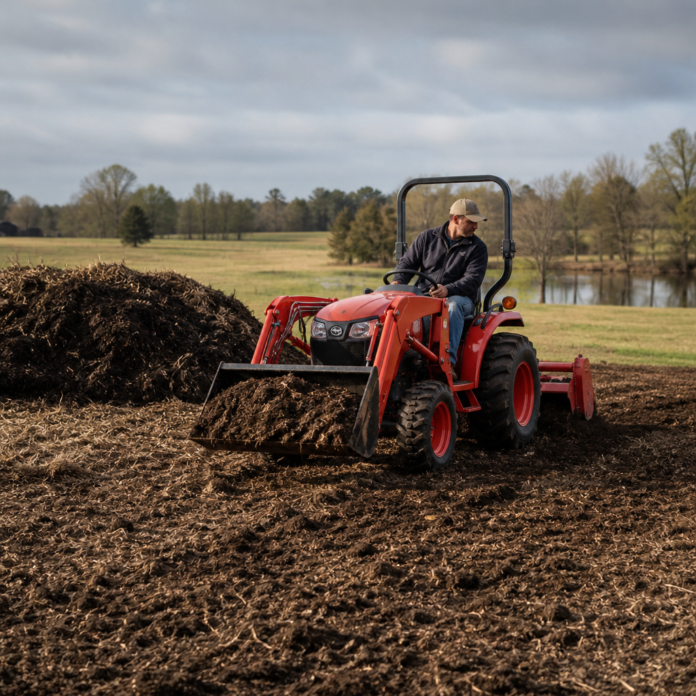

Most people buying their first compact tractor shop the wrong number. They compare engine horsepower across brochures, pick the biggest figure their budget allows, and then discover that the loader won’t lift a round bale, the three-point hitch won’t carry the mower they already own, or the machine is too wide for the lane between the barn and the pasture gate. Horsepower matters, but it is the fourth or fifth most useful number on the page. Hydraulic flow, lift capacity at the pins, PTO horsepower and physical weight tell you far more about what a day’s work will feel like.
This is a guide to sizing a tractor and implement package around real tasks on small acreage — the kind of decision that quietly sets your operating costs for the next decade.
Start With a Task List, Not a Horsepower Target
Write down every job you expect the machine to do in a year, then note the heaviest and the most frequent. Those are two different things, and they pull in opposite directions. Moving gravel and lifting pallets once a month argues for weight and loader capacity. Mowing eight acres of pasture every ten days in June argues for PTO horsepower, a comfortable seat and a tight turning radius.
A rough field guide for compact and utility classes:
- Under 25 engine HP: mowing, light box-blade work, small loader tasks, food plots. Easy on turf, limited on ground-engaging implements.
- 25–40 HP: the sweet spot for 5 to 40 acres. Runs a 5–6 foot rotary cutter, a mid-size tiller, a post driver, and handles small square bales comfortably.
- 40–65 HP: true utility territory. Round baling with smaller balers, heavier tillage, bale spears, loader work that moves real volume.
- 65 HP and up: hay on a commercial schedule, big discs, grain cart duty — more machine than most hobby acreage needs.
One habit that saves money: check PTO horsepower, not engine horsepower, against implement requirements. Driveline and hydraulic losses typically eat 12 to 18 percent, so a 37-horsepower engine may deliver closer to 30 at the PTO shaft. Implement manufacturers publish minimum PTO requirements for a reason.
Weight, Traction and the Four-Wheel-Drive Question
Loader capacity on paper means nothing if the rear end lifts off the ground. Ballast — loaded rear tires, a weight box, or simply a heavy implement left on the hitch — is what turns a rated lift figure into usable work. Ask what the machine weighs with a loader installed and fluids topped off, because that number predicts stability on slopes, bite in wet clay, and whether you’ll be spinning on a gravel pile.
Four-wheel drive is close to standard in this class now and worth having for loader work, hills and mud. The trade-off is slightly wider turning radius and more driveline components to service. If the machine will spend most of its life on manicured turf, consider turf tires and a hydrostatic transmission; if it will spend its life pulling, industrial tires and a gear transmission with a creeper range may serve better.
Hydraulics Deserve a Closer Look
Rear remote valves are the feature buyers forget and then pay to retrofit. Grapples, hydraulic top links, tilt cylinders on box blades and hydraulic bale spears all need a remote circuit. Specify at least one rear remote on a new order, two if you anticipate a grapple. Also note total hydraulic flow in gallons per minute — low flow makes a loader feel sluggish even when its lift rating looks fine.
Build the Implement Package Before You Sign
Implements should match the tractor’s category hitch and its rear tire width. A 6-foot rotary cutter on a tractor with a 62-inch rear track leaves uncut strips on every turn. Buying the tractor and implements as a package also avoids the classic mismatch: a quick-attach loader bucket that doesn’t share a plate standard with the grapple you add two years later.
For a typical small-farm starter set, think in this order:
- Loader with quick-attach plate and a bucket sized to the machine, not oversized.
- Rotary cutter or finish mower, matched to track width.
- Box blade or rear blade with scarifiers for driveway and lot maintenance.
- Ballast box or loaded tires.
- Pallet forks — unglamorous and used more than almost anything else.
Before committing, run the arithmetic on cost per hour rather than purchase price alone. Land-grant extension services publish machinery cost worksheets that break out depreciation, repairs, fuel and labor; Iowa State’s guidance on estimating farm machinery costs is a sound, neutral framework for comparing a smaller machine you’ll work hard against a larger one you’ll underuse. The same logic applies to field efficiency and throughput — there’s a point where faster machine speed stops improving yield and profitability and starts raising repair bills and operator fatigue instead.
Where Dealer Support Changes the Math
Two tractors with similar specs can cost very different amounts to own, and the difference usually comes down to parts availability and who services the machine. If a filter or hydraulic hose takes a week to arrive in the middle of first cutting, the spec sheet becomes irrelevant. That is the argument for buying from a dealership with a staffed parts counter and a service department within a reasonable drive — and for asking, before you buy, how routine wear items are stocked. Readers comparing platforms often find brand-versus-brand breakdowns more useful than catalog pages: H&R Agri Power, an authorized Kubota dealer selling new and used tractors, pre-built and custom Kubota tractor packages and genuine Kubota parts across Kentucky, Tennessee and Indiana, publishes a side-by-side look at the Kubota vs New Holland compact tractor question for small farms that works through exactly the loader, hitch and hydraulic trade-offs described above. Their locations also handle equipment repair and service, including lawn mower repair in Owensboro, which matters if the same shop will eventually see your machine for a 400-hour service.
Genuine Parts: When It Matters and When It Doesn’t
Not every component needs to come in a branded box. Shear bolts, tines and generic hardware are fair game for aftermarket sourcing. But there are places where genuine parts earn their keep:
- Filters: hydraulic and engine filtration tolerances vary more than the price difference suggests, and modern common-rail diesels are unforgiving about fuel contamination.
- Seals and gaskets: a leaking transmission seal costs ten times its price in labor to replace twice.
- Emissions and electronic components: sensors and regeneration hardware on Tier 4 engines are not generic.
- Anything under warranty: keep the paperwork and the correct part numbers.
A Seasonal Service Rhythm That Prevents Breakdowns
Downtime almost always traces back to something skipped. A simple calendar beats a thick manual nobody opens.
Spring
Change the oil, test the battery, check belts and hoses, and grease every fitting you can find before the first busy week. Check the coolant level and condition, and look at tire pressures after a winter of sitting.
Hay Season
Grease the mower and baler daily, blow out radiators and air filters at the end of each day, and keep a spare set of shear bolts and filters on the shelf.
Fall
Service the fuel system, check the block heater, and treat diesel against gelling before the first hard freeze.
Winter
Park with a full tank, a trickle charger on the battery, and the loader and implements set down, not left hanging on hydraulics.
The Decision That Ages Well
Buy for the hardest job you’ll actually do, not the biggest number on the brochure. The right compact tractor is the one that lifts what you lift, pulls what you pull, and is still running — with parts available — when the next season starts.

