
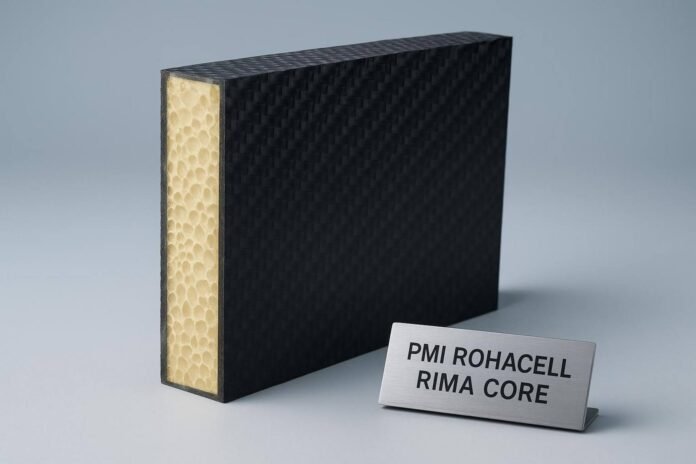

The main benefits of Rohacell RIMA foam in advanced engineering projects come from its ability to combine the strength of closed-cell polymethacrylimide (PMI) with a very low, controlled resin uptake of about 50 g/m². By limiting unwanted resin absorption during liquid composite molding while handling pressures of up to 0.7 MPa at high temperatures, RIMA helps solve a long-standing design problem: how to keep a structure light while using fast, high-pressure composite production methods. This balance makes it a useful core material for aerospace, motorsport, marine, and high-frequency radome structures.
When engineers choose core materials for demanding service conditions, they often face problems such as core crushing, cell cracking, or added weight caused by resin entering open cells. Choosing Rohacell RIMA Foam from Chem-Craft gives manufacturers access to PMI cores made for infusion and resin transfer molding (RTM). The material offers even stiffness in every direction and good heat resistance, helping manufacturers make safety-critical composite panels that meet strict weight limits without weakening the finished part.
How Rohacell RIMA Foam Improves Weight-to-Performance Efficiency
Reduces Structural Weight Without Sacrificing Stiffness
Lower weight in transport and aerospace structures can increase payload, reduce fuel use, and improve acceleration. Rohacell RIMA lets engineers create sandwich panels with a large moment of inertia without adding much structural mass. As a light spacer between carbon-fiber or fiberglass skins, the core greatly increases panel bending stiffness as its thickness increases, while adding only a small amount of weight.
Compared with solid composite laminates without a core, sandwich panels using 51 or 71 RIMA can reach similar bending stiffness with much less material. Removing several solid laminate plies can produce large mass savings. This helps design teams meet strict deflection limits while lowering the total weight of a vehicle or component.
Increases Specific Compressive Strength and Bending Performance
Specific strength compares a material’s ability to carry a load with its density. This is an area where Rohacell RIMA performs better than many general-purpose core foams. Standard polymer foams may suffer cell-wall buckling under medium compressive loads or local forces across the panel. RIMA reaches compressive strength-to-density ratios of about 0.023 MPa·m³/kg in the 71 grade and 0.033 MPa·m³/kg in the 110 grade. This gives the skins better protection against wrinkling.
During bending at several load points, sandwich beams with RIMA cores move stress from the tension skin to the compression skin through the core’s high shear modulus. The 110 RIMA grade can reach a shear modulus of up to 70 MPa. Its elongation at break of about 7% also helps protect the core from sudden brittle shear failure. Instead, the foam can turn impact loads into slower deformation and controlled energy absorption.
Supports Thinner Skins and More Efficient Composite Designs
RIMA gives the outer skins steady, even support, which allows engineers to use thinner face sheets. In honeycomb structures, thin skins can show “telegraphing” or dimpling over the open cells. Extra plies are often added just to prevent buckling between the cells. RIMA’s small, dense surface cells remove this issue and support thin carbon prepreg or low-weight unidirectional tape across the panel.
This allows designers to size the face laminates around actual tensile and membrane loads instead of adding plies to cover weak points between the core and skin. The finished laminate can be lighter and smoother while still meeting the required aerodynamic shape.
How Density Affects Mechanical Properties and Project Cost
Rohacell RIMA’s performance rises in a predictable way as density increases. 51 RIMA is a good choice for interior shells, radomes, and secondary aerodynamic fairings where shear loads are fairly low. Moving to 71 or 110 RIMA brings large gains in shear strength, rising from about 0.8 MPa to 2.4 MPa, along with higher compressive modulus. These stronger grades are suited to primary flight surfaces and automotive suspension parts.
Higher density also raises material cost. The denser grades use more closely packed polymer and require more raw material. Engineering teams can use finite-element topology studies to place higher-density foam only around load-entry areas or bolt inserts. Lower-density RIMA can be used across larger sections of the structure, creating a practical balance between performance and production cost.
How Rohacell RIMA Foam Performs Under Heat, Compression, and Fatigue
Maintains Dimensional Stability at Elevated Processing Temperatures
Modern composite methods such as RTM, vacuum-assisted infusion, and autoclave curing often use cure temperatures from 120 °C to 180 °C. Many structural foams soften, release gas, or shrink under these conditions. Rohacell RIMA is made to resist heat-related distortion, so it keeps its shape and cross-section during demanding cure cycles.
Standard RIMA grades can handle cure temperatures up to 130 °C. For high-temperature epoxies or bismaleimides (BMI) that need longer cures up to 180 °C, the heat-treated RIMA-HT grade can be used. Its stabilized polymer structure limits internal pressure buildup and holds close dimensional tolerances inside closed metal molds.
Resists Creep and Compression Under Sustained Loads
Creep is a major risk in sandwich structures that carry a constant preload, use mechanical fasteners, or face ongoing outside pressure. Rohacell RIMA resists compressive creep even when processing pressures of up to 0.7 MPa are applied at high resin temperatures. The foam does not easily relax or become thinner during long autoclave cycles.
This resistance helps in areas that use bolts and hard-point inserts. In bolted joints and clamping zones, the foam resists long-term settling, so the torque on structural bolts is less likely to drop during service. The core keeps steady outward support, preserving laminate preload and reducing the chance of joint loosening caused by vibration.
Improves Dynamic Strength and Fatigue Life
Repeated loading, gusts, and engine vibration can create fatigue cracks in standard composite cores. Rohacell RIMA has an even microstructure with very few voids, density changes, or irregular cells that could create high-stress areas. This makes it harder for small cracks to start and spread through the core.
In repeated tension-compression and bending tests, sandwich beams made with RIMA have lasted through millions of reverse-bending cycles without core-skin separation or major core breakdown. This fatigue performance makes the foam suitable for long-service wind turbine parts, helicopter tail rotor structures, and marine hulls exposed to repeated wave impacts.
How Temperature Affects Strength, Stiffness, and Service Performance
As service temperature rises near the upper limit, all polymer materials lose some modulus and yield strength. Rohacell RIMA shows a relatively steady reduction in performance compared with crosslinked PVC or polyurethane foams. Its glass transition temperature is above common aircraft operating ranges, allowing it to retain much of its shear and compressive stiffness during continuous hot and humid service.
Very cold and cryogenic conditions, such as those found at high flight altitudes or on space-transport fairings, do not cause severe embrittlement in the PMI polymer chains. RIMA avoids the sharp drop in fracture toughness seen in some unplasticized core materials at low temperatures. It can keep its planned safety range from deep sub-zero conditions through high post-cure temperatures.
Where Rohacell RIMA Foam Delivers the Greatest Engineering Benefits
Aircraft Interiors, Fairings, Nacelles, and Structural Panels
Commercial and military aircraft use Rohacell RIMA to reduce dead weight in primary and secondary assemblies. In engine nacelles and acoustic belly fairings, the foam offers heat resistance and acoustic damping while staying stable near operating engines.
In the cabin, RIMA supports lightweight overhead bins, galley partitions, and floor panels. Its stiff backing helps manufacturers meet panel puncture and edge-crush requirements with fewer skin plies. This can reduce aircraft fuel use over many years of operation.
Uncrewed Aerial Vehicles and Advanced Air-Mobility Structures
Long-endurance uncrewed aerial vehicles (UAVs) and electric vertical takeoff and landing (eVTOL) aircraft operate under very strict weight limits. Each extra gram of structure can reduce battery range, sensor payload, or hover time. RIMA helps engineers build light, stiff monocoque fuselages and long, narrow wings that can handle high-g maneuvers without unwanted flutter.
eVTOL programs also need short production cycles to reach commercial volumes. Since RIMA can handle fast, high-pressure RTM and compression molding without core crushing, it can support the short cycle times associated with automotive-style production for urban air mobility fleets.
Automotive Body Panels, Motorsport Components, and Mobility Systems
In Formula 1, the World Endurance Championship, and high-end vehicle production, the ratio of stiffness to weight has a direct effect on track performance. RIMA is used in aerodynamic front splitters, rear diffuser tunnels, monocoque safety cells, and structural undertrays that must withstand high aerodynamic loads and impacts with curbs.
In electric road vehicles, RIMA is being used in lightweight battery enclosures and structural crash beams in subframes. Its low thermal conductivity of 0.029-0.032 W/m·K creates a built-in barrier that slows heat movement during a battery thermal-runaway event. Its compressive strength also helps shield lithium cells during side impacts.
Medical Imaging Equipment and Precision Housings
Medical systems such as X-ray inspection beds, CT scanners, and patient-positioning tables need support structures that combine high stiffness with good radiolucency. The core must let X-rays pass through with little scattering or internal shadowing so image quality remains clear.
Rohacell RIMA has low density, high purity, and an even closed-cell structure, giving it low X-ray attenuation. Manufacturers can make thin, rigid carbon sandwich beds that support heavy patients without large deflections. The low attenuation also helps imaging systems create clear diagnostic images at lower patient radiation doses.
High-Performance Sporting Goods and Marine Structures
Racing sculls, performance surfboards, professional hockey sticks, carbon bicycle wheels, and racing skis need fatigue resistance, quick mechanical response, and low swing weight. RIMA provides bending damping and torsional stiffness, helping transfer an athlete’s effort into forward motion instead of losing energy through core movement.
In luxury yachts and offshore racing boats, RIMA is used in superstructures, deck bulkheads, and radar arches. Its closed-cell structure limits water entry if the outer gelcoat or skin is damaged at sea. This reduces the risk of hidden core decay and weight gain caused by moisture.
When Complex Geometry and High-Temperature Processing Justify PMI Foam
Some projects reach a point where lower-cost core materials can no longer meet the production or service needs. If a part has compound curves that require thermoforming, cures above 120 °C under autoclave pressure, and needs liquid infusion without extra resin weight, lower-cost PVC or honeycomb cores may become difficult to use.
Under these conditions, Rohacell RIMA can justify its higher purchase price. The extra material cost may be offset by fewer rejected parts, less need for heavy adhesive films, shorter cure cycles, and the removal of complicated edge-potting work required for open-cell honeycombs.
How Rohacell RIMA Foam Compares With Other Core Materials
| Core Material Attribute | Rohacell RIMA (PMI) | Nomex / Aluminum Honeycomb | Crosslinked PVC Foam | PET Foam | End-Grain Balsa Wood |
| Cellular Structure | 100% Closed-Cell Isotropic | Open Hexagonal Cells | Closed-Cell Semi-Rigid | Closed-Cell Thermoplastic | Open Natural Cellular Grain |
| Resin Uptake Level | Ultra-Low (~50 g/m²) | High (requires thick fillets) | Moderate (100-180 g/m²) | Moderate to High (>150 g/m²) | Very High (capillary drain) |
| Max Processing Temp | 130 °C (180 °C with HT) | > 200 °C | Typically ≤ 80-90 °C | Typically ≤ 130-150 °C | Up to 150 °C (moisture-dependent) |
| Water Migration Risk | None (Surface only) | Severe (Internal channeling) | Low | Low | Extremely High (Rot/decay risk) |
| Machinability & Shaping | Micron Tolerances / Thermoformable | Complex (Crushes easily) | Easy / Limited thermoforming | Thermoformable / Difficult to cut cleanly | Moderate / Heavy tool wear |
Rohacell RIMA Foam Versus Honeycomb Cores
Nomex and aluminum honeycomb cores have long been used to obtain high shear stiffness in flat panels. They also create several production and service problems. Open cells need thick adhesive films to form bonding fillets, adding weight to the part. If a thin composite skin is damaged by runway debris or a bird strike, water can enter the cells and move through internal channels. During freeze-thaw flight cycles, this can lead to broad separation between the skin and core.
Rohacell RIMA prevents water from moving through the core because its cells are fully closed. Any moisture from an impact remains limited to an area within about 5-6 mm of the damaged spot. RIMA also removes the need for costly edge-potting compounds and extra plies used to prevent skin telegraphing. This can simplify edge finishing and reduce assembly labor.
Rohacell RIMA Foam Versus PVC and PET Foam
Crosslinked PVC foams are common in marine hulls and wind turbine blades because they cost less. However, PVC softens at relatively low temperatures, which usually limits cure temperatures to about 80 °C or 90 °C. In an autoclave or high-temperature infusion process, PVC may suffer cell collapse and unpredictable gas release, damaging the bond with the surface laminate.
Recycled PET thermoplastic foams can handle more heat than PVC, but their cut surfaces may absorb large amounts of resin, often more than 150 g/m². PET also has lower shear elongation and weaker creep performance under constant loads. RIMA provides higher strength and modulus for its weight, along with more dependable shape retention across a wider range of temperature and pressure.
Rohacell RIMA Foam Versus Balsa and Other Structural Cores
End-grain balsa has high compressive strength at a low purchase price, which makes it popular in industrial and marine construction. Since it is a natural wood product, however, its density, moisture level, and grain direction can vary. This makes high-precision aerospace calculations more difficult.
The open grain of balsa acts like a wick. It can draw in large amounts of resin during infusion and absorb water from humid air. Over time, trapped moisture can cause the balsa to rot from inside, creating hidden damage. RIMA replaces these changes with consistent factory-controlled properties and resistance to fungal rot and water decay.
Trade-Offs in Cost, Machinability, Moisture Resistance, and Certification
Choosing a core involves a balance between performance and price. Rohacell RIMA costs more per cubic meter than standard PVC, PET, or balsa cores. Projects with generous weight limits and room-temperature cure cycles may not gain enough value from the higher PMI cost.
In a full cost review, however, RIMA may offer a lower total cost over the part’s service life. Its benefits can include fast CNC machining with micron-level accuracy, thermoforming of compound curves with little core waste, no internal water damage over long service periods, and existing aerospace flight certifications.
How Rohacell RIMA Foam Supports Sustainable and Certified Engineering
Reduce Lifecycle Weight and Energy Use Through Lightweight Design
Lightweight design offers a direct way to reduce energy use and greenhouse gas emissions in transport. By removing unnecessary weight from passenger aircraft, high-speed trains, and battery-electric vehicles, sandwich structures made with Rohacell RIMA can lower fuel or electricity use throughout service.
In electric vehicles, lower structural weight can increase driving range or allow a smaller battery pack. In aircraft, every kilogram removed from the airframe can prevent the use of thousands of liters of jet fuel over the aircraft’s operating life. This helps manufacturers meet environmental goals without giving up safety or range.
Recycling and Responsible Handling of PMI Foam Components
Rohacell is a thermoset-like, highly crosslinked polymethacrylimide polymer. It cannot be melted and recycled in the same way as simple thermoplastics such as PET or polypropylene. Responsible end-of-life handling needs planned disposal and recovery routes.
Clean offcuts and machining dust should be kept out of landfills where possible and sent to high-efficiency waste-to-energy facilities. PMI contains carbon, hydrogen, nitrogen, and oxygen. Clean combustion can recover some of its stored energy for municipal electricity or industrial heat while leaving little solid ash.
Quality Systems, Traceability, and Certification Documentation
Safety-critical assemblies need repeatable production. Evonik’s production lines operate under EN 9100:2018 and AS9100:2016 quality systems. These controls help keep RIMA sheet density, cell size, and mechanical strength consistent from one batch to the next.
This process control also provides the records required by agencies such as the FAA and EASA and by defense procurement bodies. Full traceability back to the original polymerization batch gives major aerostructure manufacturers the records needed to approve primary flight parts without delays caused by repeated testing of every lot.
How Testing Validates Long-Term Reliability in Demanding Environments
Long-term performance testing for Rohacell RIMA structures uses several environmental exposure programs. These can include accelerated hot and humid aging, salt-fog exposure, repeated freeze-thaw cycles from -55 °C to +85 °C, and combined dynamic fatigue under loads in several directions.
Years of field use in civil aviation, marine systems, and orbital space equipment show that RIMA can maintain structural strength in harsh service conditions. If the core is dried, sealed, and bonded correctly inside composite skins, it resists cracking, skin separation, and mechanical damage over long service periods. This has made Rohacell RIMA a widely used core material for advanced composite engineering.

