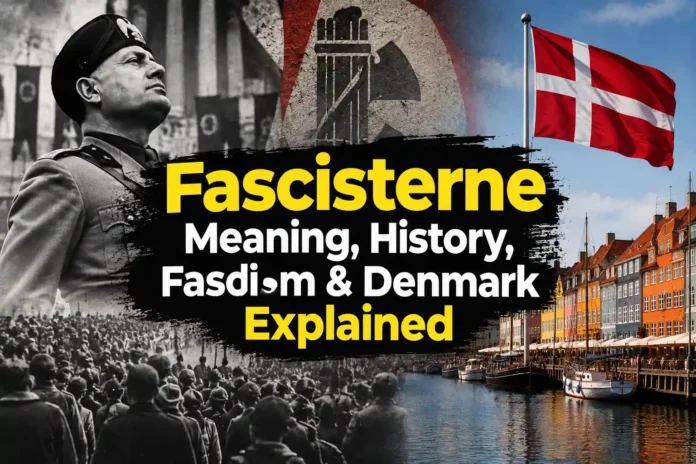

Fascisterne is a Danish word meaning “the fascists.” That translation is simple. The history behind it is anything but.
The term points toward one of the most consequential political developments of the twentieth century: the emergence of fascism after World War I, Benito Mussolini’s dictatorship in Italy, related authoritarian movements across Europe and, in Denmark, the rise of the Nazi-inspired Danmarks Nationalsocialistiske Arbejderparti, better known as DNSAP.
There is an important distinction to establish immediately. Fascisterne refers to people; fascisme refers to the ideology. It is also inaccurate to treat every authoritarian movement, every dictatorship and every form of nationalism as interchangeable with historical fascism.
Understanding the word properly therefore requires more than a translation. It requires examining what fascists believed, how fascism gained power, why Nazism was related but not identical to Italian fascism, and why Danish fascists remained politically marginal even while Denmark was occupied by Nazi Germany.
What Does Fascisterne Mean?
In Danish grammar, fascisterne is the definite plural of fascist. Its direct English equivalent is “the fascists.”
The linguistic progression is straightforward: fascist means one fascist, fascister means fascists in the plural, and the definite plural identifies a particular or understood group. Historical Danish usage of the word can be documented going back to discussions of Italian fascism in the 1920s.
That distinction matters because some online explanations present Fascisterne almost as though it were the formal name of an organization. It is not.
A Danish sentence referring to fascisterne i Italien simply means the fascists in Italy. In another context, the word might describe Danish fascists or supporters of a particular fascist movement.
Where Did Fascism Come From?
To understand fascisterne, it helps to start in Italy rather than Germany.
Benito Mussolini established Fasci di Combattimento in Milan in 1919. According to the Danish encyclopedia Lex, the emerging movement combined nationalism, anti-democratic politics, and anti-socialism with an activist political culture in which violence became an accepted method of gaining influence.
The name itself reaches further into history. Fascismo derives from fascio, meaning a bundle or group, and ultimately from the Latin fasces: bundles of rods associated with authority in ancient Rome. Fascist Italy deliberately appropriated that imagery as a symbol of unity, strength and state power.
Mussolini did not originally begin his political life on the nationalist right. He had been a socialist, but World War I profoundly altered his politics, contributing to his turn toward militant nationalism and eventually the political movement now recognized as Italian Fascism.
How Fascisterne Reached Power in Italy
The Italian Fascists did not establish a complete dictatorship overnight.
In October 1922, Fascist squads staged the March on Rome. Rather than authorizing force against them, King Victor Emmanuel III invited Mussolini to form a government, making him prime minister.
Mussolini initially depended upon the existing political system and coalition politics. During the following years, however, electoral manipulation, intimidation and institutional changes steadily dismantled parliamentary restraints.
By 1925, Mussolini had transformed his premiership into a personal dictatorship. Italy increasingly became a one-party authoritarian state in which opposition was suppressed and political power concentrated around Il Duce, “the Leader.”
This sequence is historically important. Fascist regimes did not necessarily destroy democratic institutions in one dramatic moment; existing institutions could instead be weakened, captured or stripped of practical power over time.
What Did Fascisterne Believe?
Historical fascist movements differed from one country to another, so no short checklist perfectly defines all of them. Still, scholars and historical institutions identify a recurring ideological core.
The United States Holocaust Memorial Museum describes fascism as ultranationalist and authoritarian, placing the nation above the individual while opposing pluralism, democratic government, socialism and communism. Fascist movements also treated political violence and paramilitary organization as legitimate instruments of national regeneration.
Common characteristics included:
- Extreme or exclusionary nationalism, with the political community portrayed as superior to competing identities or interests.
- Authoritarian leadership, often organized around a leader said to embody the national will.
- Hostility toward liberal democracy and pluralism, especially independent opposition and competing centres of political authority.
- Anti-communism and anti-socialism, although fascist economic policies could involve extensive state direction.
- Militarism and political violence, including paramilitary movements used against opponents.
- A narrative of national decline and rebirth, presenting society as threatened, humiliated or corrupted and promising restoration through unity and struggle.
- Subordination of individual rights to the collective nation or state, reducing the legitimacy of institutions that could restrain executive power.
These features make fascisterne more specific than simply “people with strict political opinions.” Historically, fascism represented an anti-democratic revolutionary project seeking to remake the state and society around authoritarian nationalism.
Fascisterne and Nazism: Related, but Not Identical
One of the most common historical mistakes is using fascism and Nazism as perfect synonyms.
Nazism is widely classified as a form or radical variant of fascism, but it developed characteristics of its own. Hitler’s National Socialism placed especially intense emphasis on biological racism, antisemitism, racial hierarchy and territorial expansion, culminating in genocidal policies and the Holocaust.
Italian Fascism developed differently. Antisemitism was not initially as central to Mussolini’s movement as it was to Hitler’s ideology, and Jewish Italians could even belong to the Fascist Party during its earlier years.
That changed significantly in 1938, when Mussolini’s government introduced antisemitic racial legislation restricting Jewish participation in education, government employment, marriage, the military and public life.
The distinction is useful because historically responsible writing should neither minimize fascist violence nor flatten every far-right dictatorship into precisely the same ideological model. Similarity does not eliminate difference.
Fascisterne in Denmark: The Rise of DNSAP
Denmark developed its own explicitly National Socialist movement before the German occupation.
Danmarks Nationalsocialistiske Arbejderparti (DNSAP) was founded on 16 November 1930 under Cay Lembcke. Its inspiration was unmistakable: according to Danmarkshistorien/Lex, DNSAP copied much of the German Nazi Party’s program, imagery and rhetoric, including its antisemitism, nationalism and opposition to parliamentarianism.
The imitation went beyond general political sympathy. DNSAP adopted the leader principle, used the swastika and promoted a racial worldview alongside the idea of a unified national community opposed to Marxism and liberalism.
Lembcke failed to turn this imitation of German National Socialism into a major Danish political movement. At the 1932 Danish general election, DNSAP received only 1,028 votes, approximately 0.07% of the total, and won no parliamentary seats.
Frits Clausen and the Danish Fascisterne
The movement became more visible after physician Frits Clausen replaced Lembcke as party leader in 1933.
Clausen was a strongly nationalist politician from Southern Jutland who had joined DNSAP in 1931. Under his leadership, the movement established its strongest regional support in Southern Jutland while attempting to present National Socialism in distinctly Danish nationalist terms.
The results remained modest nationally.
At the 1939 general election, DNSAP received about 1.8% of the vote and gained three seats in the Folketing. The figure is significant because it demonstrates something frequently lost in superficial accounts of fascisterne in Denmark: an organized Danish Nazi movement existed, but it never came remotely close to obtaining majority support.
What Happened to Fascisterne During the German Occupation?
Germany invaded Denmark on 9 April 1940, creating an extraordinary political situation for DNSAP.
The Danish Nazis suddenly had the most powerful Nazi state in Europe occupying their own country. Frits Clausen repeatedly demanded political power, while German financial support allowed his movement to maintain organizational and propaganda resources disproportionate to its membership.
For a time, Danish politicians genuinely feared that Germany might install DNSAP in government. Yet Berlin ultimately found the existing Danish political and administrative system more useful than handing the country directly to Clausen.
This is one of the most revealing aspects of the Danish case. Military occupation did not automatically translate into domestic electoral legitimacy for Danish National Socialism.
A parliamentary election was still held in March 1943. Despite German occupation and increased DNSAP activity, the party received 43,309 votes, or 2.1%, and retained only three parliamentary seats.
The result represented an increase in absolute votes over 1939, but hardly the political breakthrough that DNSAP expected. Denmark’s principal Nazi party remained a fringe electoral force even under conditions that might superficially appear extraordinarily favourable to it.
Collaboration Was Broader Than DNSAP Membership
Another distinction is essential when studying fascisterne during the occupation: Nazi, collaborator and German volunteer are not automatically synonymous categories.
Some DNSAP members collaborated closely with German authorities, and the party participated in recruitment associated with German military service. Yet Danish collaboration during the occupation could have economic, administrative, ideological, military or opportunistic dimensions, and not everyone involved belonged to DNSAP.
Conversely, party membership communicated a much clearer ideological association with Danish National Socialism. Treating every form of wartime accommodation as identical to fascist party membership obscures the historical record rather than clarifying it.
Why Did Danish Fascism Remain Relatively Weak?
There is no single explanation for the weakness of Danish National Socialism, but the electoral evidence is striking.
Denmark entered the 1930s with functioning parliamentary institutions and powerful mass political parties. Social Democrats, liberals, conservatives and other established organizations already represented large sections of society, making it harder for a new anti-parliamentary movement to monopolize dissatisfaction.
The Danish political system also responded to the economic and social pressures of the interwar period without collapsing. In contrast to the political breakdown experienced in Weimar Germany, Danish parliamentary democracy survived the Great Depression and remained capable of producing governments with broad electoral legitimacy.
DNSAP faced another contradiction after 1940. Its ideology celebrated nationalism, yet its political fortunes became tied to a foreign occupying power.
That tension mattered. A movement claiming to defend Danish national strength could simultaneously appear dependent upon Nazi Germany, making its nationalist message politically difficult to reconcile with the reality of occupation.
What Happened After 1945?
The defeat of Nazi Germany destroyed the political environment in which European fascist movements had flourished.
DNSAP dissolved in 1945. Frits Clausen was arrested after the liberation and died in 1947 before the criminal proceedings against him had been completed.
The party’s membership records also became the subject of lasting controversy. Resistance members seized DNSAP’s Bovrup archive in May 1945, and a publication based on the records later listed approximately 28,000 names associated with party membership.
The publication carried serious social consequences for former members, including dismissals and exclusion from organizations. Danish courts subsequently prohibited publication of the membership list, demonstrating how the legacy of collaboration and political responsibility continued well beyond liberation.
How Should the Word Fascisterne Be Used Today?
Modern political debate frequently employs words such as fascist, Nazi, authoritarian and far-right rhetorically. That does not make every use historically accurate.
Calling a person one of the fascisterne should ideally rest on identifiable ideological or organizational evidence rather than functioning simply as an insult for someone with unpopular views. Precision is particularly important because fascism describes a historically specific family of political movements associated with anti-democracy, extreme nationalism, leader-centered government and organized suppression of opponents.
Political scientists continue to debate the boundaries of the concept. That disagreement does not mean the word is meaningless; it means classification requires examining several features together rather than treating one policy, slogan, or personality trait as sufficient proof.
A politician can be nationalist without being fascist. A government can be authoritarian without reproducing classical fascism. And an extremist movement can share characteristics with historical fascisterne without being an exact recreation of Mussolini’s Italy.
That nuance strengthens historical analysis. It does not weaken it.
Fascisterne vs. Fascisme: The Essential Difference
The shortest way to avoid confusion is to separate people, ideology and political organization.
Fascisme means fascism: the ideological and political phenomenon. A fascist is a person associated with that ideology, while fascisterne means the specific or collectively understood fascists being discussed.
DNSAP, meanwhile, was an actual political party. It should therefore not be treated as another translation of the word itself.
This grammatical distinction also explains why searches for fascisterne meaning can lead to unnecessarily complicated answers. Linguistically, the translation is easy; historically, the people to whom the word refers vary according to context.
Why the History Still Matters
The lasting significance of fascism is not limited to memorizing dictators, party names or election dates.
Its history demonstrates how political movements can combine perceptions of crisis with radical nationalism, hostility toward pluralism, leader worship and claims that violence is justified by national survival. The historical fascists also illustrate why the erosion of institutions can matter long before a political system becomes a fully developed dictatorship.
The Italian example is especially instructive. Mussolini became prime minister through a combination of paramilitary pressure and decisions made within the existing constitutional order before subsequently eliminating democratic restraints.
Denmark provides a different lesson. The presence of occupation, propaganda and an organized domestic Nazi party did not guarantee mass political support for fascisterne.
Taken together, these cases show why historical context matters more than political name-calling. The strongest analysis asks not merely whether a movement appears extreme, but how it understands political authority, national identity, opposition, violence, individual rights and democratic limits.
FAQ About Fascisterne
What does fascisterne mean in English?
Fascisterne means “the fascists.” It is the definite plural form of the Danish noun fascist and therefore refers to a particular or understood group of fascists rather than to the ideology itself.
The Danish word for the ideology is fascisme. Context determines whether the term refers to Italian Fascists, Danish fascists, another historical movement or people described as fascists in contemporary discourse.
Were the Danish fascisterne the same as the Nazis?
Not exactly. Fascism is a broader political category, while Nazism refers specifically to the German National Socialist ideology developed around Hitler and the NSDAP.
Denmark’s DNSAP, however, was explicitly Nazi-inspired rather than merely generically fascist. Its original program closely copied the German NSDAP program, and it adopted elements including antisemitism, racial ideology, the leader principle and the swastika.
Did fascisterne ever rule Denmark?
No. Denmark’s principal Nazi party, DNSAP, never formed the Danish government.
Even after Germany occupied Denmark in April 1940, the occupation authorities did not install Frits Clausen as national leader. DNSAP received only 2.1% of the vote and three seats at the 1943 parliamentary election.
Who created fascism?
Benito Mussolini is generally regarded as the founder of the organized Italian Fascist movement. He founded the Fasci di Combattimento in Milan in March 1919 and became Italian prime minister after the March on Rome in 1922.
His movement subsequently dismantled parliamentary democracy and created a dictatorship. Fascist movements elsewhere borrowed from the Italian example while developing their own national characteristics.
Is it accurate to call modern political opponents fascisterne?
Only when the label is supported by meaningful ideological evidence. Disliking democracy, concentrating authority, promoting exclusionary ultranationalism, legitimizing political violence and suppressing pluralism are more relevant indicators than ordinary left-right disagreement.
Historical terminology works best as an analytical tool, not merely an insult. When discussing contemporary movements, compare their institutions, rhetoric, objectives and methods with established definitions of fascism before applying the label.
Conclusion:
At its simplest, fascisterne means “the fascists.” Understanding who those people were, however, opens a much larger story about nationalism, dictatorship, political violence, democracy and Europe between the world wars.
Start by keeping the categories separate: fascism is the ideology, fascists are its adherents, Nazism is a historically distinct radical form of fascist politics, and DNSAP was Denmark’s principal Nazi party. Then examine primary sources, electoral results and reputable historical scholarship rather than relying on modern political rhetoric alone.
That approach produces a clearer picture of both European fascism and Denmark’s experience. More importantly, it turns fascisterne from a loaded political label into a historically useful concept—one that can be examined, tested against evidence and understood in its proper context.