
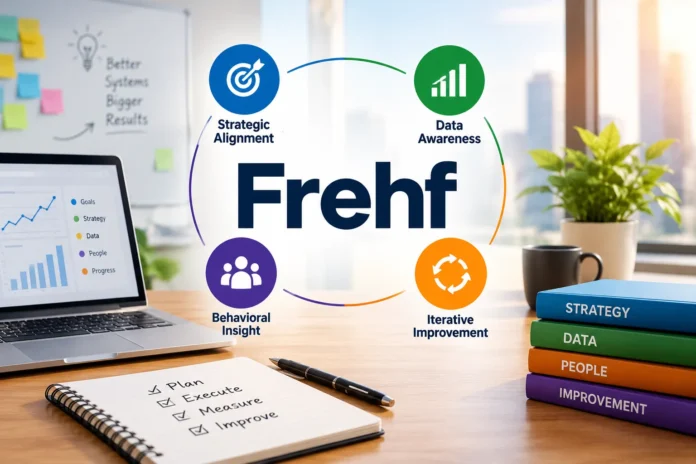

Frehf is a structured framework for improving clarity, performance, and adaptability in environments where people have to manage competing priorities, growing amounts of information, and continuous change. It brings strategy, useful data, human behavior, and continuous improvement into one practical operating model.
The central purpose is simple: make important work easier to understand, execute, measure, and improve.
Rather than adding another complicated management system, Frehf provides a way to connect long-term objectives with everyday actions. It can be applied to business operations, team performance, strategic planning, workflow improvement, personal productivity, and technology-enabled work.
At its core, the framework is built around four connected principles: strategic alignment, data awareness, behavioral insight, and iterative improvement.
What Is Frehf?
Frehf is a practical framework designed to help individuals and organizations operate with greater clarity and adaptability. It focuses on reducing unnecessary complexity and creating a stronger connection between goals, actions, evidence, and improvement.
Many performance problems are not caused by a lack of effort. They occur because priorities are unclear, information is poorly interpreted, workflows ignore human behavior, or processes continue unchanged after they stop producing useful results.
Frehf addresses these issues as parts of the same operating system.
| Core Principle | Primary Focus | Practical Purpose |
| Strategic Alignment | Goals and priorities | Connect work with meaningful outcomes |
| Data Awareness | Relevant information | Use useful signals to guide decisions |
| Behavioral Insight | Human behavior | Reduce friction and improve execution |
| Iterative Improvement | Adaptation | Refine systems through measured changes |
These four principles reinforce one another. Alignment establishes direction, data provides visibility, behavioral insight explains execution, and iteration keeps the system responsive.
The Four Core Principles of Frehf
The framework becomes most useful when its principles are treated as connected disciplines rather than independent techniques.
1. Strategic Alignment
Strategic alignment ensures that resources, priorities, responsibilities, and daily activities support the same objectives.
Organizations often experience a gap between strategy and execution. Leadership may establish clear annual goals while departments continue operating according to older priorities, conflicting incentives, or disconnected performance metrics.
The result is activity without coordination.
Frehf strengthens alignment by connecting:
- organizational objectives with team priorities;
- team priorities with specific responsibilities;
- resources with the highest-value activities;
- performance measures with intended outcomes;
- short-term execution with longer-term direction.
This creates a clearer operating structure.
For example, if a company wants to improve customer retention, customer support quality, product reliability, onboarding, account management, and relevant performance indicators should support that objective. Measuring teams primarily by activities unrelated to retention can create a strategic mismatch.
Alignment makes the relationship between work and outcomes visible.
2. Data Awareness
Modern organizations rarely suffer from a complete lack of data. More often, the challenge is deciding which information deserves attention.
Dashboards can contain hundreds of metrics. Analytics platforms can measure almost every interaction. Reports can grow longer while actual decision quality remains unchanged.
Frehf emphasizes data awareness rather than data accumulation.
Useful measurement typically includes several types of information:
Outcome metrics show whether the intended result occurred.
Leading indicators provide early evidence of future performance.
Diagnostic metrics help explain why performance changed.
Operational metrics reveal whether a process is functioning efficiently.
The distinction matters because not everything measurable is strategically important.
A marketing team, for example, might generate rapidly increasing impressions while qualified leads remain flat. Impressions describe activity and reach, but they do not automatically demonstrate business impact.
Data awareness keeps measurement tied to purpose.
3. Behavioral Insight
Processes are executed by people, which means human behavior can significantly affect performance.
Motivation, habits, cognitive load, incentives, ambiguity, resistance, attention, and workflow friction can all determine whether a theoretically sound system works in practice.
Frehf incorporates these behavioral factors directly into operational improvement.
Consider an internal process with consistently low completion rates. The obvious assumption might be that employees need additional training. Yet the underlying issue could be an unnecessarily long form, unclear ownership, duplicated data entry, poor timing, or a workflow that requires too many manual decisions.
Changing the process may produce better results than repeating the instructions.
This principle is particularly relevant to user experience, employee workflows, customer journeys, change management, digital products, and automation because all depend on how people actually interact with systems.
4. Iterative Improvement
Conditions change. Customer expectations evolve, technology develops, markets shift, teams grow, and processes that once worked efficiently can become outdated.
Frehf therefore treats improvement as continuous rather than occasional.
Instead of relying entirely on large-scale transformations, teams can introduce controlled changes, measure their effects, and refine the system over time.
A basic improvement cycle contains four stages:
- Identify a specific performance constraint.
- Change one meaningful element of the process.
- Measure the effect against an established baseline.
- Refine the system using the observed result.
Smaller changes are generally easier to evaluate because their effects can be isolated more clearly.
Iteration also reduces the cost of incorrect assumptions. A limited change can be modified or reversed without requiring an organization-wide restructuring.
How Frehf Works
The Frehf framework operates as a continuous cycle connecting direction, execution, measurement, and adaptation.
It can be summarized as:
Align → Execute → Measure → Understand → Improve
The process begins with a clearly defined outcome. Resources and responsibilities are then aligned around that outcome, relevant performance signals are monitored, behavioral or operational friction is identified, and improvements are introduced based on evidence.
Once a change is implemented, its effect becomes new information for the next cycle.
This makes Frehf especially suitable for environments where conditions cannot be predicted perfectly in advance.
Why Frehf Matters
Complexity has become a significant operational problem.
Organizations can have more software, more reports, more communication channels, and more automation while still struggling with unclear priorities and slow decisions. Adding another tool rarely solves a problem caused by poor alignment.
Frehf is useful because it concentrates attention on the relationships between the major components of performance.
It Connects Strategy With Daily Work
A strategy has limited value when employees cannot connect it to their actual responsibilities.
Frehf creates a clearer line between organizational objectives and everyday execution. This can help teams prioritize high-impact work while reducing activities that consume resources without materially supporting the intended outcome.
It Improves the Quality of Measurement
Measurement becomes more valuable when metrics have a defined purpose.
Instead of treating every available number as equally important, the framework prioritizes signals that help explain progress, risk, bottlenecks, and performance.
It Accounts for Human Reality
A technically efficient process can still fail if it is difficult for people to use.
By including behavioral insight, Frehf recognizes usability, motivation, incentives, workload, habits, and friction as operational variables rather than secondary concerns.
It Supports Adaptability
Fixed systems can become inefficient when their environment changes.
Continuous review and incremental adjustment allow processes to evolve without requiring constant large-scale restructuring.
Frehf and Human-Centered AI
Artificial intelligence and automation make human-centered operating principles increasingly important.
Automation is particularly effective for repetitive processing, pattern detection, classification, summarization, forecasting support, and other tasks that can be performed consistently at scale. Human involvement remains important where context, accountability, judgment, creativity, communication, or ethical considerations influence the outcome.
Frehf provides a useful structure for combining the two.
The objective is not simply to automate the largest possible number of tasks. It is to use technology where it improves the overall system while preserving appropriate human oversight.
A well-designed AI-enabled workflow may therefore include:
- automated processing for repetitive tasks;
- human review for consequential decisions;
- clearly defined decision ownership;
- performance monitoring;
- mechanisms for identifying errors or unexpected behavior;
- regular workflow refinement.
This creates human-centered automation rather than automation for its own sake.
Frehf vs. Traditional Automation
Traditional automation commonly begins with a task: determine whether it can be completed by software with less manual work.
Frehf takes a broader systems view.
| Traditional Automation | Frehf Approach |
| Focuses primarily on automating tasks | Focuses on improving the complete workflow |
| Often prioritizes speed and efficiency | Balances efficiency with outcomes and usability |
| May treat human intervention as an exception | Defines where human judgment adds value |
| Measures system output | Connects measurement with intended outcomes |
| Can create fixed automated processes | Supports continuous adjustment |
| Usually begins with technology | Begins with the objective and operating context |
This distinction becomes important as organizations adopt generative AI and increasingly autonomous systems.
A faster process is not necessarily a better process. If automation increases errors, reduces accountability, creates customer friction, or optimizes an irrelevant activity, the apparent efficiency gain can become an operational cost.
Frehf vs. Agile, Lean, and OKRs
Frehf overlaps with several established management approaches, but its scope is different.
Frehf vs. OKRs
Objectives and Key Results (OKRs) primarily help organizations define objectives and measurable results.
Frehf extends beyond goal setting by incorporating behavioral factors, operational signals, execution, and ongoing process improvement.
The two can work together. OKRs can define important outcomes while Frehf helps organize the operating system used to pursue and refine them.
Frehf vs. Agile
Agile emphasizes iterative delivery, feedback, collaboration, and responsiveness to change, particularly in product and software environments.
Frehf also values iteration, but places additional emphasis on strategic alignment, behavioral insight, and distinguishing useful signals from informational noise.
Frehf vs. Lean
Lean focuses heavily on customer value, waste reduction, flow, and continuous improvement.
Frehf shares the preference for reducing unnecessary complexity but explicitly combines this with strategic alignment, data interpretation, and human behavioral factors.
These approaches do not need to compete. An organization can use established methodologies while applying Frehf as a broader lens for alignment and adaptation.
Practical Applications of Frehf
The framework is intentionally broad enough to work across different operational environments.
Business Operations
Businesses can use Frehf to connect strategic objectives with workflows, responsibilities, and performance indicators.
Suppose order fulfillment is becoming slower as a company grows. The framework can be used to clarify the required service level, identify the stage creating delays, analyze employee and customer friction, modify the workflow, and monitor the resulting performance.
This creates an evidence-based improvement process rather than an assumption-driven redesign.
Strategic Planning
Long-term plans become less reliable when market conditions change quickly.
Frehf can support adaptive strategic planning by maintaining clear objectives while allowing execution methods to evolve as new information becomes available.
This creates stability in direction without unnecessary rigidity in execution.
Product Development
Product teams constantly balance business objectives, user needs, technical constraints, and behavioral data.
The framework can help maintain alignment between these variables.
User behavior can reveal friction. Product analytics can identify patterns. Research can explain why those patterns occur. Controlled changes can then improve the experience without requiring a complete redesign.
Customer Experience
Customer journeys often cross marketing, sales, onboarding, support, billing, and product teams.
Problems emerge when each department optimizes its own metrics while the complete customer experience remains fragmented.
Frehf encourages cross-functional alignment around the actual customer outcome.
That can reveal problems such as duplicated information requests, slow handoffs, confusing communication, unnecessary approval stages, or performance metrics that reward departmental efficiency at the expense of customer experience.
Personal Productivity
Frehf can also be applied at an individual level.
A person can establish a clear objective, identify the activities that materially contribute to it, track a small number of useful indicators, reduce behavioral friction, and adjust routines according to actual results.
The purpose is not to maximize the number of completed tasks.
It is to improve the relationship between attention, effort, and meaningful output.
How to Implement Frehf
Successful implementation does not require rebuilding every workflow simultaneously.
A focused implementation is usually more practical.
Step 1: Define the Outcome
Start with one specific result.
“Improve customer service” is broad. “Reduce average resolution time without lowering customer satisfaction” provides a clearer operational target.
A useful outcome should be understandable, measurable, and connected to a real organizational priority.
Step 2: Map the Existing Workflow
Document how the relevant process currently operates.
Identify major stages, responsibilities, handoffs, tools, dependencies, delays, and decision points. This creates a realistic baseline instead of designing improvements around an assumed workflow.
Step 3: Identify Relevant Signals
Select a limited number of metrics that provide meaningful information about the outcome.
For customer support, these could include resolution time, repeat contacts, escalation rate, customer satisfaction, and unresolved case volume.
The exact metrics should depend on the objective.
Step 4: Locate Friction
Analyze where the workflow becomes slower, confusing, inconsistent, or unnecessarily difficult.
Friction may come from:
- unclear responsibilities;
- excessive approvals;
- duplicated work;
- poor interfaces;
- missing information;
- competing incentives;
- unnecessary manual tasks;
- badly timed notifications;
- excessive cognitive load;
- disconnected systems.
This is where behavioral insight and process analysis meet.
Step 5: Introduce a Controlled Improvement
Change the element most likely to influence the desired outcome.
The intervention should be substantial enough to matter but specific enough to evaluate.
For example, instead of replacing an entire customer service platform, a team might first automate case categorization, simplify escalation rules, or consolidate duplicated information fields.
Step 6: Measure the Result
Compare performance with the baseline.
Look for both intended and unintended effects.
An automation might reduce handling time while increasing correction rates. A simplified checkout might improve conversions while creating more support requests. A new approval workflow might accelerate routine decisions but create additional risk for exceptional cases.
Effective measurement captures the complete effect rather than the most convenient metric.
Step 7: Standardize or Refine
Successful improvements can become part of the standard workflow.
Weak or mixed results should trigger refinement rather than automatic expansion.
Over time, repeated improvement cycles create a system that evolves through evidence rather than periodic guesswork.
Key Benefits of Frehf
The framework can provide several practical advantages when implemented consistently.
Greater Clarity
Clear outcomes and responsibilities reduce ambiguity.
People understand what matters, how their work contributes, and which activities deserve priority.
Better Resource Allocation
Strategic alignment helps prevent time, money, and attention from being distributed across low-impact activities simply because those activities have become routine.
More Useful Data
Data awareness reduces dependence on vanity metrics and oversized dashboards.
Teams concentrate on information that supports decisions and reveals meaningful changes in performance.
Reduced Workflow Friction
Behavioral insight can uncover problems that traditional process analysis misses.
Small design changes—better defaults, clearer ownership, fewer steps, simpler interfaces, or better timing—can sometimes improve execution without additional staffing or technology.
Faster Adaptation
Iterative improvement reduces dependence on infrequent major transformations.
Organizations can respond to changing conditions through smaller, measurable adjustments.
Stronger Human-Technology Collaboration
The framework provides a practical basis for deciding how technology should support work rather than assuming that every technically automatable task should be automated.
This becomes increasingly relevant as AI capabilities expand.
Challenges and Limitations
Frehf is not a substitute for expertise, leadership, reliable data, or sound judgment.
Its effectiveness depends heavily on implementation.
Poorly Defined Outcomes
If the intended result is vague, alignment becomes difficult and measurement becomes arbitrary.
Clarity at the beginning affects every later stage.
Too Many Metrics
A large measurement system can recreate the complexity the framework is intended to reduce.
Teams need enough information to understand performance, not every possible data point.
Misreading Human Behavior
Behavioral insight requires evidence.
Assuming employees resist change because they are “unmotivated,” for example, may hide poor system design, conflicting incentives, inadequate tools, or unrealistic workloads.
Over-Automation
AI and automation can improve efficiency but can also create new failure points.
High-impact decisions may require human review, transparent responsibility, and clear escalation paths even when technology performs much of the underlying analysis.
Change Without Measurement
Continuous improvement becomes random experimentation when changes are not evaluated against meaningful outcomes.
Iteration works best when the baseline, intervention, and result are sufficiently clear to support comparison.
Do You Need Special Software for Frehf?
No dedicated software is necessary to apply the core framework.
A team can implement its principles using existing project management tools, analytics platforms, spreadsheets, documentation systems, workflow software, or even simple written planning methods.
Technology can make implementation easier at scale, particularly for data collection, process monitoring, collaboration, and automation. It should remain an enabler, not the framework itself.
A sophisticated technology stack cannot compensate for unclear objectives, irrelevant metrics, poor process design, or undefined responsibility.
Frehf for Small Businesses
Small businesses can often implement the framework with relatively little overhead.
Because smaller organizations usually have fewer management layers, strategic alignment and process changes can happen quickly.
A practical small-business setup might include:
- one clearly defined quarterly objective;
- several supporting performance indicators;
- documented ownership of important workflows;
- a simple operational dashboard;
- regular review of bottlenecks;
- controlled improvements to high-impact processes.
The framework can scale as organizational complexity increases.
The priority should remain simplicity. Adding unnecessary meetings, reports, dashboards, or approval layers would work against the purpose of Frehf.
Frehf and Responsible AI
As artificial intelligence becomes embedded in business processes, performance is only one part of system quality.
Organizations may also need to consider accountability, transparency, privacy, bias, security, human oversight, and error management, particularly when automated outputs influence consequential decisions.
Frehf’s human-centered perspective fits naturally with these concerns.
An effective AI workflow should make responsibility visible. People should understand where automated outputs enter the process, where human review is required, what happens when the system produces an unreliable result, and who remains accountable for the final decision.
This prevents automation from becoming an accountability gap.
Common Frehf Implementation Mistakes
The framework can lose value when it becomes more complicated than the problems it is intended to solve.
Common implementation mistakes include:
- adopting the terminology without changing actual workflows;
- tracking activity instead of outcomes;
- automating inefficient processes without redesigning them;
- introducing too many performance indicators;
- ignoring employee or customer friction;
- making large changes before establishing a baseline;
- treating one successful intervention as permanently optimal;
- adding processes without removing obsolete ones.
The strongest implementations remain focused on clarity, evidence, people, and adaptation.
The Future of Frehf
The principles behind Frehf are increasingly relevant to organizations operating with AI, automation, distributed teams, complex data environments, and rapidly changing customer expectations.
As technology handles more operational work, organizations will need stronger mechanisms for deciding what should be automated, what requires human judgment, how outcomes should be measured, and how systems should adapt when conditions change.
This makes human-centered operational design increasingly valuable.
Frehf’s long-term usefulness will ultimately depend on practical implementation rather than terminology. Frameworks create value when they improve the quality of execution, measurement, and adaptation.
Conclusion
Frehf provides a structured way to improve how goals, information, human behavior, and continuous improvement work together. Its four core principles—strategic alignment, data awareness, behavioral insight, and iterative improvement—create a practical model for reducing complexity without sacrificing adaptability.
Its strongest application is not adding another layer of management. It is making existing work more coherent.
Start with one meaningful outcome. Connect the relevant work and responsibilities to it, measure the signals that genuinely reflect performance, remove operational or behavioral friction, and introduce controlled improvements based on results.
Used consistently, Frehf can become a practical operating framework for clearer execution, stronger workflows, and continuous adaptation.
Frequently Asked Questions
What is Frehf in simple terms?
Frehf is a structured framework for improving clarity, performance, and adaptability. It connects strategic goals with useful data, human behavior, and continuous improvement so that individuals and organizations can operate more effectively.
What are the four principles of Frehf?
The four core principles are strategic alignment, data awareness, behavioral insight, and iterative improvement. Together, they connect direction, measurement, human execution, and adaptation within a single operating model.
Is Frehf an AI framework?
Frehf is not limited to artificial intelligence. Its principles can be applied to business operations, productivity, planning, product development, customer experience, and other workflows.
It is particularly relevant to AI and automation because behavioral insight, meaningful measurement, human oversight, and continuous improvement are important when technology becomes part of decision-making and operational processes.
How is Frehf different from Agile?
Agile primarily focuses on iterative delivery, collaboration, feedback, and adapting to change. Frehf has a broader operational focus that combines strategic alignment, data awareness, behavioral factors, and continuous improvement.
Organizations can use both approaches together rather than treating them as alternatives.
Does Frehf require special software?
No. The framework can be applied using existing tools such as spreadsheets, analytics platforms, project management systems, documentation tools, and workflow software.
The important element is how goals, information, people, and improvements are organized—not which application is used.