
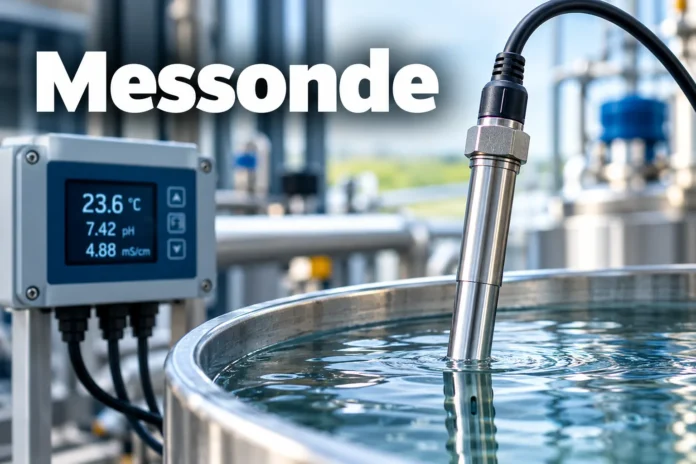

Messonde most often refers to a measuring probe when it appears in engineering, scientific, industrial, or translated product content. The spelling is closely connected with the standard German word “Messsonde,” which is commonly translated as measuring probe, test probe, or measuring sensor.
A probe detects a physical or chemical condition and sends information to a meter, controller, computer, or monitoring system. However, Messonde is not a fixed English technical term, so the source language and surrounding context still matter when deciding what it means.
What Does Messonde Mean in Technical Content?
In technical material, Messonde is best understood as a reference to a device that measures or detects a specific property. Depending on its design, a probe may measure temperature, pressure, oxygen, conductivity, humidity, liquid level, flow, or material thickness. The probe normally works as one part of a larger measurement system rather than as the complete instrument.
That broad role explains why the same term can appear around very different equipment. A probe installed in an industrial tank has different construction from one placed in a laboratory sample, even though both collect measurement data. Messonde therefore describes a measurement function more clearly than it identifies one particular product.
Why the Spelling Differs From the German “Messsonde”
The established German spelling is “Messsonde,” and German-English dictionaries translate it as “measuring probe,” “test probe,” and related sensor terms. The shorter spelling may appear after typing, copying, translation, or search variation, especially when German terminology is used outside its original source. Searching the standard spelling can therefore lead to more useful technical documentation.
The older form “Meßsonde” can also appear in older German material. It represents the same general measuring-probe concept, while modern spelling uses “Messsonde.” Readers researching a manual or part should treat these spelling differences as clues rather than assume they describe separate technologies.
How a Measuring Probe Turns a Condition Into Data
A measuring probe starts with a sensing element that reacts to the property being measured. Heat, pressure, oxygen concentration, moisture, or another condition causes a response that the sensing technology can detect. The probe then turns that response into a signal that another part of the system can interpret.
The signal may be electrical, optical, electronic, or digital. A meter can display a number, while an industrial controller can use the reading to adjust a process or trigger an alarm. Connected systems may also log, graph, transmit, or review the data through monitoring software.
This is why Messonde should not automatically be treated as the name of a complete measuring instrument. The probe may perform the sensing while transmitters, cables, electronics, controllers, displays, and software handle processing or communication. That distinction makes product specifications easier to understand.
The Main Types of Measuring Probes
Temperature, Pressure, and Humidity Probes
Temperature probes measure heat, pressure probes detect pressure in gases or liquids, and humidity probes measure moisture in air. These devices appear in manufacturing, heating systems, laboratories, engines, storage areas, and process equipment. A Messonde designed for one measurement cannot simply replace a probe built for another because each sensing method has its own range and operating limits.
Oxygen, Gas, Conductivity, and Level Probes
Oxygen and gas probes detect selected gases in air, exhaust streams, industrial processes, or liquids. Conductivity probes measure how well a liquid carries electrical current, while level probes determine how much material or liquid is present in a vessel. When Messonde appears in technical text, the material, measurement range, and environment help reveal which probe type is intended.
Flow and Material Inspection Probes
Other probes can measure flow, distance, coating thickness, surface properties, or related process variables. A coating probe may inspect paint or protective layers, while a flow probe may monitor movement through a pipe or duct. Surface condition, geometry, temperature, vibration, and contamination can all affect the quality of the reading.
Where Measuring Probes Are Used
Industrial engineering is one of the clearest settings for probe technology. Probes can sit inside pipes, tanks, ovens, ducts, vessels, machines, and production lines, while vehicles use sensors for exhaust oxygen, temperature, pressure, and fluid conditions. In translated technical material, Messonde may appear as a general probe term even when the actual component has a more specific product name.
Laboratories, water systems, and environmental testing also depend on direct sensing. Probes may measure conductivity, salinity, temperature, dissolved oxygen, chemical response, or other properties in samples and natural environments. The correct technology depends on the test method, operating conditions, and data quality required.
Weather terminology creates another source of confusion. A radiosonde is a specific atmospheric instrument commonly carried by a balloon to measure upper-air conditions such as temperature, pressure, and humidity. It should not be treated as a synonym for Messonde simply because both terms involve measurement.
Why Accuracy, Precision, and Calibration Matter
Accuracy describes how close a reading is to the true or reference value, while precision describes how consistently a system repeats its readings. A probe can be consistent and still be wrong if it has drifted away from the correct value. Reliable measurement therefore depends on both the sensing technology and the condition of the equipment.
Calibration compares a measuring system with a known reference so users can detect unacceptable error. The correct method and interval depend on the probe type, application, operating conditions, and manufacturer guidance. Calibration cannot repair every problem because damaged, contaminated, or worn sensing elements may need cleaning, servicing, or replacement.
Placement also affects quality. A temperature probe near an unwanted heat source or a liquid sensor covered in deposits may produce misleading data. Good installation is therefore part of accurate measurement, not just a mechanical detail.
Choosing and Maintaining the Right Probe
Selecting a probe starts with the property to be measured and the range in which it will operate. Users should also consider accuracy, response time, temperature and pressure limits, chemical compatibility, size, mounting method, connector type, and output signal. A Messonde that suits the measurement but not the environment can fail early or return unreliable readings.
Installation should place the sensing area where it can observe the real condition of interest. Poor contact, damaged cables, unsuitable insertion depth, loose wiring, or nearby interference can distort the result. The equipment manual should define mounting, wiring, orientation, and environmental limits.
Maintenance depends on the sensing technology and the material being measured. Water, chemicals, exhaust, food, dust, and industrial fluids can leave deposits, while aggressive cleaning can damage membranes, coatings, electrodes, or connectors. Regular inspection, correct cleaning, suitable storage, and calibration help preserve reliability.
Sensor, Probe, Radiosonde, and Online Uses Are Different
A sensor is a broad component that detects a physical or chemical change, while a probe usually describes the part positioned in or near the material being tested. In some products, the sensor and probe form one assembly, so the terms overlap. In other systems, the sensing element, probe body, electronics, and display remain separate.
A radiosonde is narrower because it is an atmospheric instrument that transmits weather observations. The exact spelling Messonde is also used online as a brand-style name or loosely defined idea associated with curiosity, learning, or exploration. Those uses should remain separate from the established German measurement term.
Claims that Messonde is a specific software platform should be checked against an identifiable developer, official documentation, product details, and other primary evidence. A repeated description on general websites is not enough to establish a product or technical standard. Context and primary documentation are more reliable than the spelling alone.
How to Identify Messonde Correctly From Context
Start with the source language and nearby terminology. References to calibration, measurement range, temperature, pressure, conductivity, oxygen, controllers, tanks, or industrial systems strongly suggest the technical Messsonde connection. References to a publication, website, personal-growth theme, or named online service may instead indicate branding or a coined use.
Next, identify what the supposed device measures and how it connects to the rest of the system. Product specifications should reveal its sensing range, output, compatible environment, mounting arrangement, and intended application. If those details are missing, the word alone is not enough to identify a precise device type.
For technical searches in 2026, established terminology remains the safest route to useful documentation. Search for “Messsonde” with the measurement type, such as temperature, oxygen, conductivity, pressure, or level, and use English alternatives such as “measuring probe” when useful. That approach reduces ambiguity without inventing a new meaning for an unclear spelling.
Final Takeaway
Messonde is most useful as a context-dependent spelling that often points to the German technical term Messsonde, meaning a measuring probe. These probes can detect many physical or chemical properties in industrial systems, vehicles, laboratories, environmental testing, water analysis, and material inspection. Their exact function depends on sensing technology, range, installation, calibration, and operating environment.
The important distinction is between the spelling and the actual device. A technical document may use the term around genuine measurement equipment, while a website or brand may use the same letters for something unrelated. Checking spelling, source language, nearby terminology, and product specifications usually reveals which meaning applies.
Frequently Asked Questions
Is Messonde a standard English dictionary word?
No, it is not a widely established English technical term. Its meaning depends on context. In engineering material, it often points toward the German word Messsonde.
What does Messsonde mean in English?
Messsonde generally means “measuring probe” or “test probe.” It describes a device that detects a measurable property. The exact function depends on the application.
Is Messonde the same as a sensor?
Not exactly. A sensor detects a condition, while a probe often describes the assembly placed near the material being measured. Some products combine both functions.
What can a measuring probe detect?
A probe can detect temperature, pressure, oxygen, conductivity, humidity, level, flow, thickness, or other properties. Its sensing technology determines what it can measure.
Why does calibration matter?
Calibration compares a measurement with a known reference. It helps reveal unacceptable error or drift. Damaged or contaminated probes may still need servicing or replacement.
Is this the same as a radiosonde?
No. A radiosonde is a specific atmospheric instrument used for upper-air observations. The technical spelling here more often points toward the broader German term Messsonde.
Can the term refer to a website or online concept?
Yes, the spelling can be used as a brand or coined online term. That usage is separate from German measurement terminology. Context determines which meaning applies.
How should I search for technical information?
Search for “Messsonde” with the measurement type or application. You can also try “measuring probe” or “test probe.” Those terms usually produce more precise technical results.