
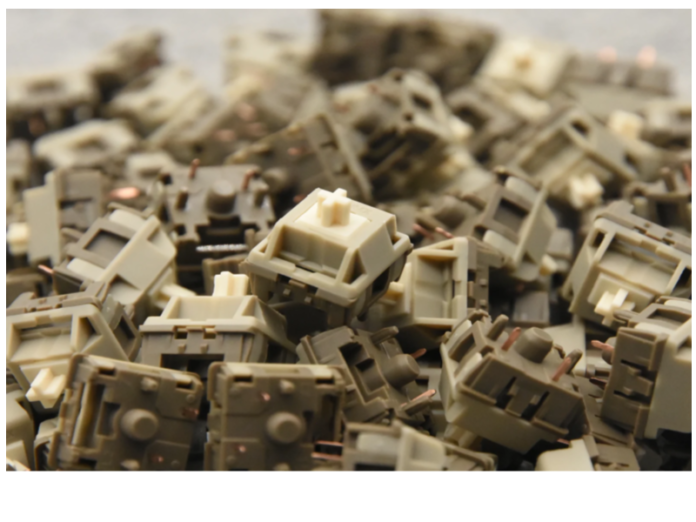

Smoothness has long been one of the most frequently discussed qualities of a mechanical keyboard switch.
Manufacturers refine stem molds, adjust housing materials, and experiment with lubrication to reduce unwanted friction. For many enthusiasts, a nearly frictionless keypress represents the ideal linear switch.
The HMX Rain challenges that assumption.
Designed by Youth Studio and manufactured by HMX, the Rain is a five-pin linear switch built around a deliberately textured typing sensation. Its rail bottom-out construction and material choices aim to deliver consistent feedback throughout the stroke rather than the glassy smoothness many users expect.
This raises a question: why would a manufacturer intentionally create a linear switch that feels scratchy?
Linear Does Not Necessarily Mean Frictionless
Mechanical switches are generally classified by how their force changes during a keypress.
A tactile switch incorporates a designed force event that creates a noticeable bump. A conventional linear switch does not have that intentional tactile bump.
But linear does not mean completely free from friction.
As a switch moves, the stem slides against internal housing surfaces. The interaction between those surfaces can produce different sensations depending on the materials, finish, geometry, and lubrication.
A switch can therefore remain linear while offering noticeable surface texture.
The HMX Rain explores precisely this distinction.
Its design attempts to create a consistent sandy sensation throughout the keypress rather than the irregular, unwanted scratchiness sometimes associated with poor manufacturing or uneven lubrication.
The Role of Rail Bottom-Out
One defining feature of the Rain is its rail bottom-out, commonly abbreviated as RBO.
The structure changes how the switch reaches its mechanical stopping point and contributes to the overall character of the keypress.
In the Rain, that arrangement is paired with an intentionally textured travel experience.
The switch has a published total travel of 4.0 ± 0.2 mm, longer than many modern linear switches designed around shortened travel distances.
That full-travel specification is relevant for users who prefer a more traditional keypress distance.
It does not necessarily mean slower typing or reduced responsiveness. Total travel and the actuation point are different measurements, and the effect on actual typing depends heavily on the user.
What matters is that Rain combines a relatively conventional travel distance with a distinctive end-of-stroke structure.
How Materials Shape the Experience
The HMX Rain uses PA66 top and bottom housings with a POM-blend stem.
According to the original retail description, the housing design incorporates matte guide rails and updated molding features intended to produce a more consistent textured sensation.
The manufacturer-selected material combination is intended to make that texture predictable rather than random.
This distinction is important.
Unwanted friction can feel inconsistent, with certain parts of a switch’s travel catching or resisting movement unpredictably. Rain’s design goal is a more uniform sensation from the beginning to the end of the stroke.
That does not guarantee that every user will enjoy it.
Someone accustomed to polished, extremely smooth linear switches may interpret the intended texture as roughness. Another user may find the same feedback engaging and easier to perceive during everyday typing.
Why Factory Lubrication Does Not Eliminate the Texture
The Rain is factory-lubed, which might initially seem contradictory.
Why lubricate a switch specifically designed to retain friction-related feedback?
The answer lies in the difference between controlling unwanted mechanical noise and eliminating all surface sensation.
Published product descriptions explain that the Rain uses a selective lubrication approach, including thin dry-film treatment on certain internal components and lubrication around spring-contact and leaf-related areas.
The intention is to control unwanted metallic noise while preserving the texture associated with the stem and guide rails.
This also creates an important consideration for keyboard enthusiasts who routinely disassemble and relubricate their switches.
Applying heavy amounts of lubricant may alter the characteristic feel that makes the Rain distinctive.
More lubricant is not automatically an improvement when the original design deliberately retains a certain amount of surface feedback.
Force Selection Still Matters
The Rain’s tactile character should not be confused with its spring resistance.
Different spring configurations can produce lighter or firmer keypresses while retaining the same fundamental textured design.
For example, KeebPilot’s detailed listing for HMX Rain distinguishes 37g, 42g, and 48g actuation-force configurations, with separate bottom-out specifications for each version.
Retailers may carry different subsets of the available variants, so the precise operating and bottom-out forces should always be checked against the version being ordered.
A lighter spring will not turn the Rain into a perfectly smooth linear switch. Likewise, a heavier spring does not transform its textured travel into a conventional tactile bump.
The design concept remains the same.
Sound Is a Separate Consideration
The HMX Rain is sometimes described as crisp or clacky in product discussions.
Those descriptions are useful as subjective impressions, but they should not be treated as guaranteed acoustic properties.
The keyboard case, plate, keycaps, mounting system, desk surface, and recording equipment can all influence the sound.
A rail bottom-out structure may contribute to the perceived impact character, but it does not determine the finished keyboard’s sound in isolation.
Anyone comparing Rain sound tests should pay attention to the complete keyboard configuration, not just the switch name.
When Texture Is a Feature—and When It Is Not
The Rain is interesting because it makes an unusual design preference explicit.
A builder who wants the smoothest possible switch may reasonably reject it. That is not a failure of the product’s stated design goal.
A builder who enjoys mechanical feedback but does not want a conventional tactile bump may find the concept appealing.
The important buying distinction is whether the texture is desired.
As with other five-pin MX-style switches, PCB compatibility also needs to be confirmed. The Rain is a conventional mechanical switch and should not be purchased as a replacement for a Hall Effect magnetic switch.
Trying a small number of switches in the intended keyboard is often more informative than relying entirely on descriptions of smoothness or scratchiness.
Conclusion
The HMX Rain demonstrates that linear-switch development does not have to move in only one direction.
Removing friction is one design objective. Controlling and shaping the sensation of friction can be another.
By combining intentional surface texture, selective lubrication, a rail bottom-out design, and full mechanical travel, Rain offers a different interpretation of what a linear switch can feel like.
Its appeal is not universal, and that is precisely why it deserves attention.
The most useful measure of a switch is not whether it conforms to one definition of perfection, but whether its design characteristics match the typing experience someone actually wants.
If you want to try a deliberately textured linear switch, you can buy HMX Rain switches at KeebPilot. Review the available force options and confirm your keyboard’s compatibility before ordering.